
The Discipline of Strategic Subtraction
Even in the evolving economics of DSOs, the math is simple. If your 2027 business plan adds six new initiatives but subtracts zero, you’re just accumulating promises that compete for the same limited pool of resources.
As an organization leader, the tendency to add comes naturally. But your strategic agenda is now a commuter train at rush hour, filled with uncomfortable, unfulfilled endeavors that would love nothing more than to get off at the next stop.
A more thoughtful voice tells you that your team can’t do everything you envision without becoming dispirited and exhausted. You’re also wary of the sunk-cost fallacy—continuing a project simply because you’ve already invested so much in it.
If this feels familiar, your most important task right now is deciding which initiatives get to thrive in a more spacious environment and which will be shown the door. It’s also an opportunity to create a stop list and develop the habit of constantly evaluating what works and what goes in the trash bin.
Your Strategic Agenda Is Competing with Itself
To understand how to winnow your initiatives list, look no further than Jim Collins’ 2001 book From Good to Great, which remains hugely influential, in part for having minted the idea of the Stop- Doing List.
“Most of us lead busy but undisciplined lives,” Collins writes. “We have ever-expanding ‘to-do’ lists, trying to build momentum by doing, doing, doing – and doing more. And it rarely works. Those who build the good-to-great companies, however, made as much use of ‘stop-doing’ lists as ‘to-do’ lists. They displayed a remarkable discipline to unplug all sorts of extraneous junk.”
The stop-doing list treats initiatives as a zero-sum game: you can’t, without adding labor costs, heap more work onto the same people without creating leaks that threaten success.
Identifying what to stop is crucial now because the DSO world has changed to the point where organic growth within existing practices beats practice acquisition.
“What passed for growth in the expansion years was often just accumulation,” writes Mike Huffaker, CRO for Planet DDS, in the company’s 2026 Dental Industry Outlook report. “Buy enough practices fast enough, and the aggregate numbers look impressive. Until those practices need to actually perform. The DSOs that will win from here … are the ones who can demonstrate consistent, repeatable results across their locations.”
The numbers back this up. According to 2026 surveys by the American Dental Association Health Policy Institute, “… practices are placing greater emphasis on how capital decisions affect cash flow, operational capacity, and implementation complexity. The focus is not only on what to purchase, but on how to move forward efficiently in a constrained environment.”
Stopping ends at least one throwinggood- money-after-bad thread. It also demonstrates that organizational leaders can be introspective, thoughtful, strategic, and nimble.
Adding Is Easy. Subtraction Is Excruciating.
If killing a once-treasured initiative is uncomfortable, remember that the more intellectually honest and emotionally intelligent response to something that isn’t working is to try something different. Responsible leadership means enabling your team to succeed, not ensuring they fail.
And remember that humans default to addition by nature.
“Addition is attractive because it gives leadership action a visible form: a programme to announce, a KPI to track, a governance forum to chair, or an initiative to report against,” writes CEO and leadership expert Kieran Gilmurray.
“Subtraction is harder because its value is less visible. This bias is not just organizational; it is cognitive.”
Gilmurray notes that research published in Nature found “subtractive solutions” are often overlooked; he also cites a Harvard Business Review article by Leidy Klotz showing that more than 90 percent of stakeholder improvement ideas are additive rather than subtractive.
To be clear, this isn’t just about terminating initiatives that don’t work—simple elimination because something isn’t working is the behavior of an organization in a death spiral.

Ceasing one initiative should always be followed by shifting resources to something else. After closing one door, usher your people through another to start a new and exciting project.

Strategic Reallocation, Not Cost Cutting
The distinction between ending an initiative and cutting costs is significant. While the latter is often a frantic effort to keep the organization afloat by any means necessary, the former is characterized by several strategic questions:
- Was the original initiative hypothesis correct?
- Why does the team feel the initiative has not worked?
- Would continuing the initiative be patient or lazy?
- Was the original event horizon realistic? Should we create a new one?
- Did we fund the initiative sufficiently?
Answering these questions should make it easier to reach a decision on whether to stop or continue, but you and your leadership team must embrace the spirit of strategic resource allocation and convey a nimble, responsive, insightful energy to the team.
“Respondents who report that their organizations reallocate resources across business units within the year are much more likely than respondents who report no in-year reallocation to say their organizations outperform on both revenue growth and return on capital,” writes McKinsey in a summary of a company survey.
Set Your DSO Resources Free
So how do Stop-Doing List strategies relate specifically to DSOs?
DSOs often find that vendor contracts with automatic renewals no longer pass muster. Similarly, fear of interrupting a patient stream may convince some dental organizations to stagnate under unprofitable PPO terms.
DSOs must be willing to periodically evaluate existing contracts’ impact on profitability and make changes accordingly. When margins shrink, look at existing relationships and stop doing what’s hurting your business.
What else can you strategically stop doing? Consider these candidates, common across many modern businesses, not just DSOs.
- Duplicate software platforms: What redundancies do you have? Which pricey applications do you use just 10 percent of? Which platforms can you replace at half the cost?
- Multiple reporting systems: Do you have siloed systems that don’t communicate? Is it hard to extract and cross-reference data?
- Long-running pilots: Do you have pilots that never reached production because of bottlenecks, incompatibility, or failed data transfers?
- Underperforming locations: Are some practices struggling?
- Low-ROI marketing programs: Do your marketing programs deliver? Do you have standards of success for them?
Efficiency requires the flexibility to move resources where they’re most needed. Leaders must develop a healthy emotional distance when evaluating initiatives and a dancer’s instinct to pivot when the music changes.
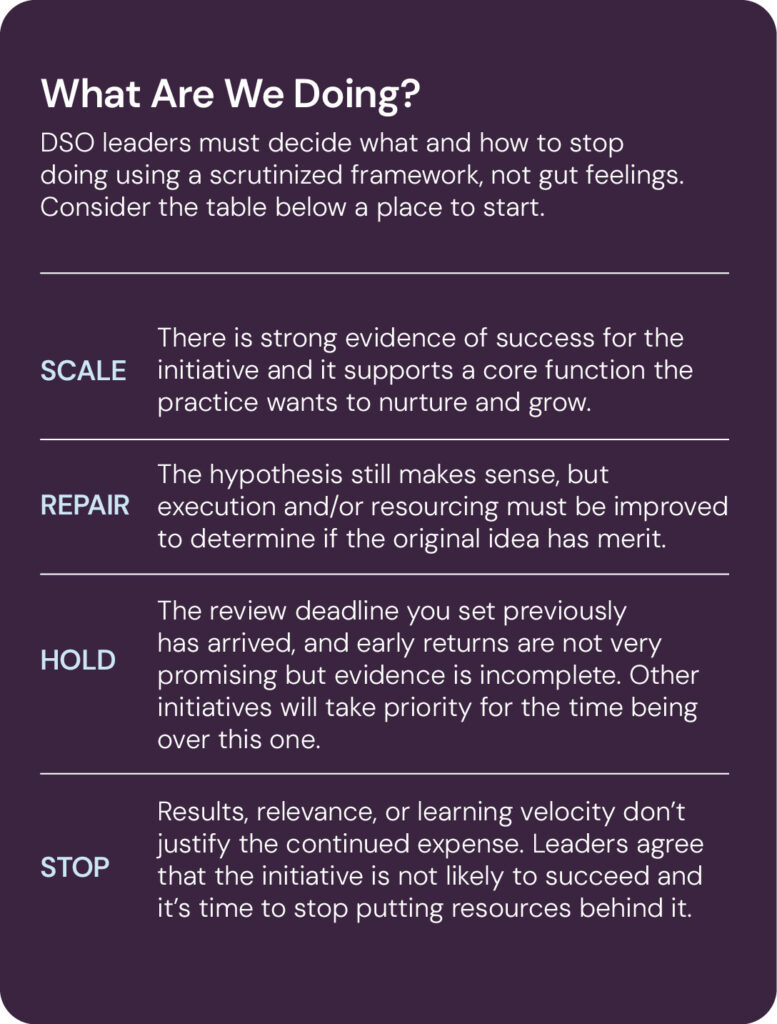
Whether you use this framework or another, a regular evaluative process is essential. If an initiative has no evidence of value, it shouldn’t continue.
Moving forward, no new initiative should get a green light until it has owners for these criteria:
- Original strategic hypothesis
- Executive owner
- Total cost, including labor and leadership attention
- Success measures and baselines for continuation
- Evidence achieved to date
- Consequences of stopping
- A scheduled scale, repair, hold, or stop decision
This process isn’t defined only by elimination—it’s not complete until resources are reassigned to an existing or new project.
How will your team respond? That depends on the culture you’ve created. Does your team expect the same job day in and day out, or are they excited by new challenges? Put another way, do they understand why stopping matters as much as starting?
Learning to Start Stopping
The reasons change is hard include self-justification, reputational protection, the sunk-cost fallacy, fear, and errors of commission and omission. Research also shows that leaders who demonstrate a renewed commitment to failing initiatives are considered more trustworthy by their colleagues, creating a negative feedback loop that has little to do with actual initiative success.
Which is why peer review, quantitative and qualitative analysis, and emotional detachment matter more than the temporary energy of a rousing team meeting. If an initiative continues to fail and threatens organizational viability, a kumbaya moment won’t stave off decline. It’s not that enthusiasm is bad; it’s that it can masquerade as analysis where none exists.
Every organization is doing something that isn’t working, and someone right now is renewing their commitment to it instead of stopping. So ask yourself: What am I going to stop funding today, and where will those resources go instead?