Inside the decisions driving growth
Growth has a way of making organizations look stronger.
A larger practice network, a fuller sales pipeline, or a new technology platform can signal momentum. But none guarantees that patients receive better care, clinicians become more effective, or the business creates lasting value. Across dentistry, the executives responsible for revenue and growth are confronting that distinction and reconsidering what deserves investment, what requires reinvention, and what should be left behind.
We spoke with six Chief Revenue, Growth, and Commercial Officers from DSOs and industry partners about the decisions shaping dentistry’s next chapter. Their perspectives range from technology infrastructure and customer adoption to clinical innovation, capital allocation, and the human realities of practice partnerships.

They do not offer a single formula. They challenge assumptions about scale, identify value hidden inside existing organizations, and describe moments when the right commercial decision is to say no.
Together, their answers reveal a more demanding definition of growth: not simply building a bigger revenue engine, but building one that produces better outcomes.

As the DSO market matures, what has stopped working in the traditional growth playbook, and what is replacing it?
The traditional playbook was largely built around aggregation: acquire practices, centralize functions, reduce costs, and use multiple expansion to create value. That model becomes much harder when acquisition multiples rise, capital costs more, labor is constrained, and reimbursement isn’t keeping pace with inflation.
I think the next phase of DSO growth is less about practice count and more about how much economic potential an organization can unlock from each practice, provider, chair and patient relationship, while improving the patient and provider experience.
If acquisitions become harder, more expensive or less available, where would you place your next dollar to drive organic growth—and why?
I would put it into productive capacity and demand conversion, but selectively. I would identify practices with strong underlying demand, stable providers, and constrained capacity, then prioritize investment in those locations.
That could mean recruiting, facility improvements, additional chairs, extended hours, digital marketing, or improvements to call conversion and scheduling.
The important distinction is that I wouldn’t spread the dollar evenly across the organization. Capital should follow demonstrated opportunity. Find offices and markets where incremental capacity or demand can produce the highest return, invest disproportionately, measure the result, and repeat.
Where is the biggest untapped economic opportunity inside the existing DSO patient base—and why aren’t organizations capturing more of it today?
I think it is patient lifetime value, particularly the intersection of retention, diagnosed-but-unscheduled treatment, hygiene/recall, and specialty leakage.
DSOs spend enormous energy acquiring new patients while sometimes allowing tremendous value to leave through the back door. A patient who doesn’t reappoint, never completes diagnosed treatment, or gets referred outside the organization represents both an access failure and an economic loss.
Some organizations may manage these as separate departmental metrics. The patient doesn’t experience those silos. There is enormous value in creating a longitudinal view of the patient journey and systematically asking a question: What does this patient need next and how do we make it easy for them to receive it within our system?
What conventional wisdom about building or scaling a DSO do you believe is wrong? What convinced you otherwise?
The notion that standardization means every practice should operate the same way.
Scale absolutely requires standards, systems, and accountability. But I’ve become increasingly convinced that standardization and uniformity are not the same thing.
A Medicaid-heavy pediatric practice does not have the same operating model as a fee-for-service GP practice. A mature practice doesn’t have the same growth constraints as a de novo. I’m convinced a better model is to standardize the operating principles, data, and expectations, while allowing teams flexibility in how they solve local constraints.
What convinced me was seeing capable operators perform better when they understood the objective and were empowered to solve the problem—not simply told to follow a centrally designed playbook.
Growth leaders constantly choose between opportunities. What’s the hardest thing you’ve had to say “no” to—and what made you walk away?
The hardest is saying no to growth itself.
It’s very difficult for a growth leader to recommend walking away from a market, an acquisition, or a strategic initiative. There are situations where the capital and leadership attention required, or the operating complexity created to generate another dollar of revenue, do not produce an adequate return.
I’ve also become much more comfortable asking a question: If we weren’t already doing this, would we invest in it today? If the answer is no, sunk cost or historical attachment shouldn’t change the decision. Sometimes the best growth decision is to stop investing somewhere so you can allocate resources where you have a real opportunity to win.
Where is AI creating significant economic value for DSOs—and where is the industry getting ahead of the actual value it can deliver?
The most compelling AI applications today are relatively practical—clinical decision support, documentation, patient communication, call intelligence, scheduling, revenue-cycle workflows, and tools for identifying operational patterns humans can’t efficiently find across hundreds of practices.
Where I think we’re getting ahead of ourselves is treating AI as a strategy rather than a capability. Ultimately, the value must show up in the P&L or in measurable clinical outcomes.

How are the needs and buying behaviors of DSOs and dental practices changing—and how is that affecting your growth strategy?
DSOs used to shop for practice management software. Now they’re evaluating infrastructure. The conversation has shifted from just “can this schedule appointments” to “can this give me visibility, standardization, and EBITDA growth across 50 locations.” That shift is being accelerated by private equity due diligence. Buyers are now scrutinizing technology stacks the way they scrutinize financials, and fragmented systems are now showing up as valuation risk, not just an operational headache.
For us, that means our growth strategy is now an infrastructure strategy. We’ve invested in becoming the platform that connects practice management, revenue cycle, and imaging on a single data layer because that’s what determines whether a DSO can actually scale, not just add locations.
Where do you see the greatest underserved customer need, market segment, or business model that represents a significant growth opportunity? Why has the industry struggled to address it?
Data utilization. Every DSO with 20 or more locations is sitting on years of clinical, operational, and financial data that’s often inaccessible. It lives in disconnected systems, formatted differently at every location, with no common structure to benchmark against. They can’t see why location A outperforms location B. They can’t track whether a clinical protocol is being followed consistently. They can’t get ahead of a revenue-cycle problem before it shows up in the financials.
The industry hasn’t solved it because it requires building from the data layer up, not bolting analytics onto existing software. That’s hard and expensive, and most vendors optimized for something else. The DSOs that figure out how to actually use their own data are going to compound in ways others won’t be able to match. This data layer has become even more critical to enable DSOs to find value from agentic and AI solutions.
What is one widely accepted belief about partnering with DSOs that you believe is wrong? What have you learned that convinced you otherwise?
The belief that a DSO’s size is a reliable indicator of its readiness to execute change at scale. Scale is not the same as readiness. I’ve seen large groups struggle to execute a technology transition because they never built the change-management muscle, and I’ve seen a 15-location group execute flawlessly because leadership was aligned and disciplined about it.
What convinced me otherwise is watching implementations up close. The variable that predicts success isn’t location count; it’s whether the organization is willing to standardize, hold people accountable to new workflows, and stay the course through the disruption that always comes before the growth. Size gets you in the room. Readiness gets you the results.
Have you ever walked away from revenue because it wasn’t the right approach for the client or your business?
Yes, and the clearest version of it is walking away from a deal where the organization isn’t actually ready to change. You can close the contract. But if leadership isn’t aligned, if there’s no internal accountability for new workflows, or if the attitude is “we’ll adopt this around how we already work” then you’re setting up a failed implementation and a damaged relationship.
I’d rather have that honest conversation before signing the contract than after. The deals we’ve walked away from for those reasons weren’t losses. They were situations where saying yes would have been worse for everyone. The customers who weren’t ready at first and came back a year later when they were—those became some of our strongest relationships.
What is the most difficult judgment call you routinely have to make that a dashboard can’t make for you—and what have you learned about making that call well?
Reading whether a DSO’s stated interest is real momentum or polite noise. Enterprise sales cycles can run multiple years, and pipeline data will tell you a deal is “in progress” long after it’s gone cold. No dashboard tells you when a champion has lost internal influence or when “we’re evaluating this quarter” is genuine.
What I’ve learned is that this call gets made through pattern recognition built over hundreds of deals, not a single signal. And when I genuinely can’t get a clear read, I make a call… literally. I’ll pick up the phone and connect with the DSO’s leadership directly to understand where the project actually stands. That conversation tells you more in five minutes than months of CRM activity.

How are the needs and buying behaviors of DSOs and dental practices changing—and how is that affecting your growth strategy?
Three things have changed.
1. Buyers moved from buying features to buying outcomes. The question is no longer “What does it do?” but “What does it replace, and what does it return?” Specifically, how does it help me grow?
2. There are many stakeholders and they all need to be taken into account to drive success. Operations, finance, IT, marketing, etc., are all thinking about how they use technology to drive their key outcomes.
3. Groups are consolidating vendors. Every added system is another integration, another training burden, another security review.
That has reshaped our strategy in a specific way. We invest more before the sale, in discovery, and in a real business case, and far more after it. Growth in this market compounds through adoption and expansion, not signatures. If a customer isn’t seeing adoption in a specific area, or isn’t seeing the growth in a practice management software change, it is on us to work hand in hand with them to help support the outcomes they want to see—whether it’s higher collections, fewer claims denials, or better culture scores.
Where do you see the greatest underserved customer need, market segment, or business model that represents a significant growth opportunity? Why has the industry struggled to address it?
The emerging growth practices have outgrown tools built for a single practice but cannot absorb enterprise implementations designed for hundreds of sites. They have not yet established large-scale business operations and need technology to help them succeed. They are also one of the fastest-growing segments in dentistry.
The industry has struggled here because the economics are awkward. Solo-practice products are built for volume and patient focus; enterprise products are built for customization and centralization. The mid-market needs enterprise capability delivered with small-business simplicity, which is a model loaded with variables and tough to build.
Where is AI creating significant economic value—and where is the industry getting ahead of the actual value it can deliver?
The clearest value today is in the administrative layer, where the work is repetitive, rules-based, and measurable. This includes functions like insurance verification, claims and denials, patient communication, schedule gap filling, call handling, and clinical documentation. These include the potential for significant ROI with hours returned to a team that is already short-staffed and dollars that were previously written off. You can measure them inside a single billing cycle.
What is one widely accepted belief about partnering with DSOs that you believe is wrong? What have you learned that convinced you otherwise?
I see some technology vendors who care more about “winning the deal” than the actual work, which comes afterwards. Great marketing and selling can get a DSO to say yes, but what actually matters is after that—when you work with the DSO on change management, adoption, and growth, aligning the work to their overall vision.
Outcomes in a DSO happen everywhere—at the front desk, in the operatory, when patients are trying to schedule an appointment, and when accounting is trying to collect. Understanding the breadth of stakeholders and what matters to them (and therefore, the organization) is essentially the only thing that matters.
What is the most difficult judgment call you routinely have to make that a dashboard can’t make for you—and what have you learned about making that call well?
When a customer is not seeing immediate results, it is important to look at whether it is a people problem, a process problem, or a product problem. The dashboard might show me low utilization. It cannot tell me why, and those three causes call for completely different responses. Maybe they need a road map change, more of our people involved, or an honest conversation with their executive team.
This is often when the team needs to do more firsthand detective work—visiting the practice; talking to the office managers. The person doing the work at 7:45 in the morning will tell you the truth in about four minutes. Data tells you where to look, but you need to do more work to figure out the story.
Have you ever walked away from revenue because it wasn’t the right approach for the client or your business?
Yes, and having the integrity to do this is critical to long-term partnership success. The most common version is a customer who wants to buy something we make for a problem it was not built to solve. It is tempting. The prospects are ready, the number is good, and you can talk yourself into “we’ll make it work.” You rarely do.
The harder version is timing. We have worked with customers to battle-test expansions, and we have paused implementations to incorporate team learnings into the process. In the end, that builds trust and, ultimately, more successful partnerships.


How are the needs and buying behaviors of DSOs and dental practices changing, and how is that affecting your growth strategy?
While the fundamentals haven’t changed, the decision-making process has become more disciplined. DSOs and private practices continue to look for solutions that improve clinical outcomes, increase efficiency, and deliver meaningful economic value. What’s different today is the greater emphasis on standardized workflows, measurable ROI, and solutions that can scale across multiple providers and locations.

As a result, our growth strategy is increasingly focused on procedure-based solutions rather than individual products. We are investing in technologies that help practices improve treatment acceptance, increase productivity, and unlock new revenue opportunities. Filtek™ Matrix is a great example. It enables clinicians to offer minimally invasive composite veneer treatments through a predictable digital workflow, creating an affordable esthetic option for patients while helping practices grow elective procedure revenue.
Where do you see the greatest underserved customer need, market segment, or business model that represents a significant growth opportunity? Why has the industry struggled to address it?
The greatest opportunity remains prevention and minimally invasive dentistry.
Despite widespread awareness of the connection between oral health and overall health, many patients do not receive preventive treatment consistently. Preventive therapies have often been viewed as clinical necessities for certain patients, rather than opportunities to improve patient experience and practice growth.
Another opportunity is making cosmetic dentistry more accessible. Many patients desire smile improvements but are discouraged by the cost or invasiveness of porcelain veneers. Filtek™ Matrix enables clinicians to deliver conservative, additive composite veneer treatments through a digital workflow that reduces overall procedure time. The result is an affordable solution for patients and a new growth opportunity for practices.
What is one widely accepted belief about partnering with DSOs that you believe is wrong? What have you learned that convinced you otherwise?
One common misconception is that DSOs only make purchasing decisions based on price.
While cost management is important, the most successful DSOs are focused on creating consistency, improving patient outcomes, supporting provider adoption, and delivering sustainable growth across their organizations. They are looking for strategic partners that can help them solve operational and clinical challenges at scale.
What we’ve learned is that the strongest DSO partnerships are built around shared business objectives rather than transactional purchasing conversations. When you can demonstrate how a solution improves workflow efficiency, increases treatment acceptance, enhances the patient experience, or supports practice economics, the conversation becomes much more strategic than simply discussing product cost.
What is the most difficult judgment call you routinely have to make that a dashboard can’t make for you—and what have you learned about making that call well?
The most difficult judgment call I make is deciding when to stay the course versus when to redirect a strategy that appears successful on paper. Dashboards can show pipeline growth, bookings, and activity levels, but they can’t always reveal changing customer priorities, competitive shifts, or whether a team’s effort is aligned with the biggest future opportunities.
I’ve learned that making this call well requires listening beyond the data. I look for signals from customers, frontline leaders, and the market to determine whether momentum is real or simply inertia. The hardest part is having the conviction to pivot before the numbers demand it.
Some of our best outcomes have come from reallocating resources, changing go-to-market approaches, or pursuing different opportunities before the dashboard reflected the need. Experience has taught me that strategic leadership is often about anticipating change, not reacting to it.
Have you ever walked away from revenue because it wasn’t the right approach for the client or your business?
Absolutely. One of the most important responsibilities of any business leader is knowing when to walk away.
There have been situations where a customer wanted a solution that I knew wouldn’t deliver the outcomes they were expecting or where the deal structure required concessions that would create a poor result for either organization. In those cases, I’ve chosen to be transparent about the risks rather than pursue the revenue.
While it can be difficult to walk away, I’ve found that protecting trust, ensuring customer success, and maintaining strategic discipline ultimately create more value over time. In several instances, those same customers returned later when we were better aligned because they respected the honesty and consultative approach.
I believe sustainable growth comes from creating mutual value not simply closing transactions. If a deal isn’t in the best interest of the customer or compromises the business, I’d rather lose the opportunity than win the wrong business.

What conventional wisdom about building or scaling a DSO do you believe is wrong? What convinced you otherwise?
One piece of conventional wisdom I believe is wrong is that scale alone creates efficiency.
Many organizations assume that adding practices, providers, and patients naturally makes operations easier because fixed costs spread across a larger base. In reality, scale amplifies both strengths and weaknesses. Broken processes become bigger problems. Poor communication creates more confusion. Weak data quality creates greater financial risk.
What convinced me otherwise was seeing firsthand how quickly complexity grows in large organizations. Sustainable growth isn’t simply about adding locations—it’s about building repeatable systems, strong leadership, accountability, and a culture rooted in Amazing Customer Service, so that growth never comes at the expense of the patient experience or the people delivering it.
Growth leaders constantly choose between opportunities. What’s the hardest thing you’ve had to say “no” to—and what made you walk away?
One of the hardest decisions as a growth leader is saying no to opportunities that show potential but lack the organizational capacity to execute well.
Early in my career, I pursued nearly every opportunity because growth felt synonymous with progress. Experience taught me that focus creates more value than volume.
The hardest opportunities to walk away from are the ones that look strategically attractive but distract the organization from its highest priorities. When resources, leadership attention, and execution bandwidth become fragmented, even good opportunities can produce poor outcomes.
Today, I ask two questions when evaluating an initiative: Does this move us materially closer to our long-term strategy? And does it make life better for the patients, team members, and doctors we support? If either answer is unclear, saying ‘no’ is usually the more responsible decision.
What’s the hardest part of your role that people outside the position rarely see or fully appreciate?
What people often don’t see is the constant balancing of competing priorities across patients, providers, team members, operational leaders, external partners, and financial performance.
In healthcare, decisions rarely have just one stakeholder—most involve trade-offs. A change that improves efficiency may affect provider workflows. A financial decision may impact patient experience. A growth initiative may require significant operational support.
The hardest part of the role is keeping those decisions aligned with the organization’s long-term strategy while maintaining trust and partnership across every constituency. Much of leadership happens behind the scenes—through alignment, communication, and relationship building—long before results become visible.
What’s something you believed about leadership earlier in your career that experience has since proven wrong? What changed your mind?
Early in my career, I believed strong leaders needed to have all the answers. Over time, I learned that effective leadership is less about having answers and more about asking the right questions, building the right team, and creating an environment where people can perform at their best.
The turning point came as I moved into larger leadership roles, where the complexity of decisions and challenges became too great for any one person to solve alone. I realized leadership isn’t about being the smartest person in the room—it’s about bringing together talented people, empowering them, and aligning them around a common goal.
The best leaders I’ve worked with create clarity, remove obstacles, and help others succeed.
What book or podcast has recently influenced your leadership approach?
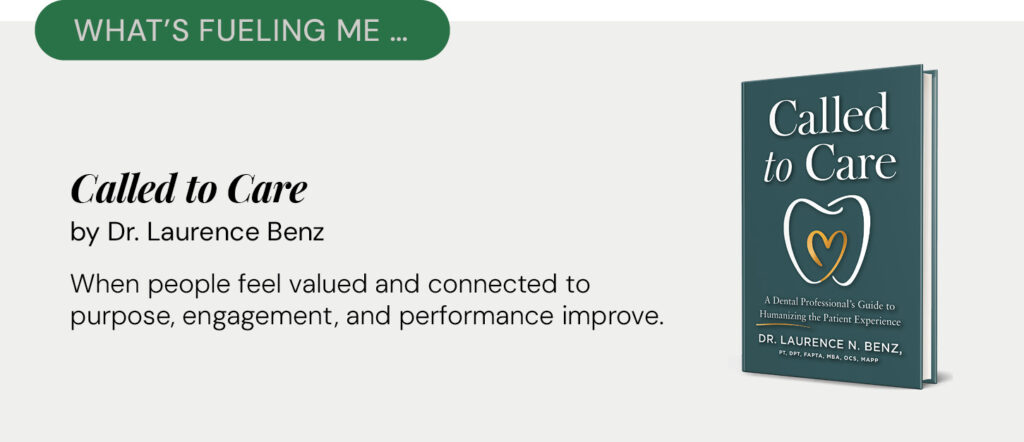
One book that has significantly influenced my leadership approach is Called to Care by Dr. Laurence Benz.
What resonates most is its focus on servant leadership and the idea that the most effective organizations put people at the center of everything they do. In healthcare, it’s easy to get consumed by metrics and operational challenges. The book reminds us that sustainable success starts with genuinely caring for patients, team members, and the communities we serve.

What’s the hardest part of your role that people outside the position rarely see or fully appreciate?
The emotional side of growth. We talk constantly about EBITDA, acquisitions, same-store growth, integration, and KPIs. But behind every one of those numbers are human beings.
For a doctor who has spent 20 or 30 years building a practice, partnership is not simply a transaction. It can involve identity, legacy, fear, excitement, loss of control, and an enormous amount of trust.
I think one of the most important parts of my role is meeting doctors in that space because I have lived it myself. Growth leaders have to understand the spreadsheet, but we also have to understand the person sitting across the table.
The numbers may get a deal closed. Trust is what determines what happens afterward. If we want doctors to stay, lead, grow, and become champions of an organization, we have to support the human journey just as intentionally as we manage the financial one.
As the DSO market matures, what has stopped working in the traditional growth playbook, and what is replacing it?
The next era of DSO growth will be defined by the quality of that growth. Acquisitions create opportunity, but lasting value comes from what happens afterward: healthier practices, stronger teams, better patient care, and doctors who want to stay and build.
I believe the next era is about organic growth, doctor alignment, and creating environments where great clinicians actually want to stay, lead, and build. That means investing in people, leadership, systems, patient experience, and helping doctors grow clinically and economically.
The organizations that win will not be the ones that simply aggregate the most EBITDA. They will be the ones that create a platform where entrepreneurship can actually thrive at scale. I am a huge believer that ownership does not have to mean the end of entrepreneurship. Done right, partnership should give doctors more resources, more opportunities, and a bigger sandbox to build in.
What separates a DSO that is truly creating enterprise value from one that is simply getting bigger?
Same-store growth. You can make a company look impressive by adding locations, revenue, and EBITDA through acquisitions. But I want to know what happened to the practices after you bought them.
Are they growing? Are the doctors more engaged? Are teams stronger? Is the patient experience better? Are doctors doing more of the dentistry they love? Are leaders being developed inside the organization?
To me, enterprise value is created when one plus one actually equals three.
That is also why culture is not a soft metric. Culture shows up in retention, recruiting, case acceptance, productivity, patient experience, and ultimately EBITDA.
Where is the biggest untapped economic opportunity inside the existing DSO patient base—and why aren’t organizations capturing more of it today?
Comprehensive care. Most dental organizations do not have a patient acquisition problem nearly as much as they have a patient utilization problem. There are patients already sitting in our chairs who need periodontal care, implants, orthodontics, restorative dentistry, sleep treatment, endodontics, oral surgery, and countless other services.
But capturing that opportunity cannot mean selling more dentistry. It means diagnosing better dentistry.
That distinction matters.
The opportunity is creating systems where clinicians communicate, specialists collaborate, patients understand their disease and options, and care does not fall through the cracks because of a broken handoff or referral process.
As a periodontist, I have spent my career believing that interdisciplinary care creates better outcomes. When we build systems that make comprehensive care easier for both the patient and the provider, the economics follow the clinical excellence, not the other way around.
What conventional wisdom about building or scaling a DSO do you believe is wrong? What convinced you otherwise?
That scale requires standardizing everything.
I believe you need consistency around expectations, financial discipline, data, compliance, and accountability. But standardization becomes dangerous when it strips away the very things that made a practice successful in the first place.
Doctors are entrepreneurs. Their practices have personalities. Their teams have history. They have deep roots in their communities. I have become convinced that the better question is not, “How do we make every practice the same?” It is, “What should we solve together that allows each practice to become an even better version of itself?”
Scale should create leverage without eliminating identity. I spent years building my own practices, and I know how personal that journey is. That perspective shapes how I think about partnership today. The goal should not be to turn entrepreneurs into employees. It should be to give entrepreneurs infrastructure, community, and resources they could never build alone.