
Dental Group Signal’s Recruitment Visibility Benchmark compared 11 major US dental groups with its UK Enterprise cohort. Both cohorts were led by a score of 98. A separate 27-group UK Mid-Tier study showed that the same standard is less common below enterprise scale.
A Public Test of Recruitment Readiness
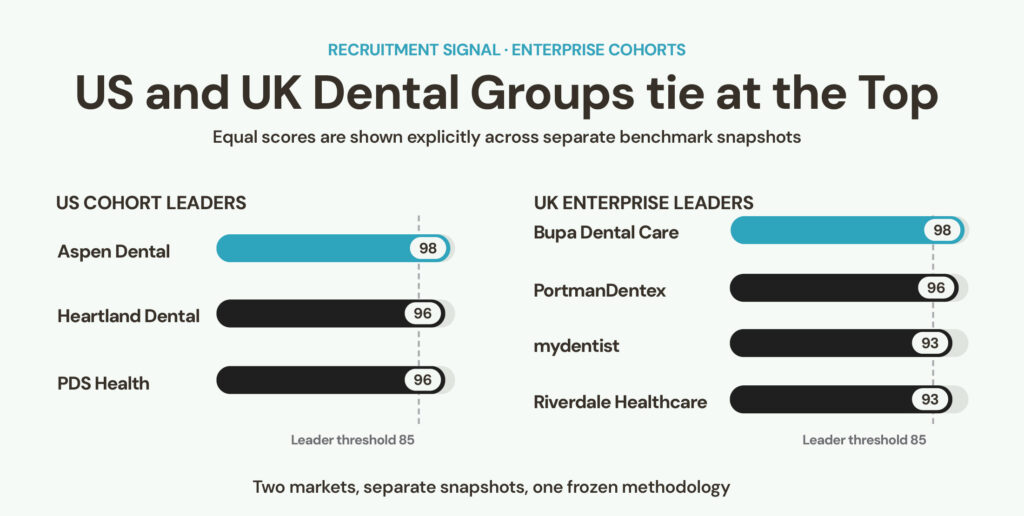
Aspen Dental led Dental Group Signal’s 2026 USA Recruitment Visibility Benchmark with a score of 98. Heartland Dental and PDS Health shared second place with scores of 96.
For growth-minded dental groups, these public signals matter because every acquisition, de novo opening, and expansion plan ultimately depends on attracting clinicians fast enough to staff the chairs.
The benchmark measures a narrow but commercially relevant question: What can a prospective clinician verify before making contact?
The assessment covers nine public signals, including careers-page access, current roles, application friction, working application routes, the candidate proposition, clinical development, dentist-specific recruitment, culture and people evidence, and recruitment activity on LinkedIn.
It does not measure whether somebody enjoys working for a group. It does not test retention, pay competitiveness, clinical standards, or hiring results. It records the recruitment system that the market can see on a stated date.
What the US Leaders Make Visible
Seven of the 11 US groups reached the Leader band of 85 or above. This article profiles the top three score positions rather than publishing every Leader-band group.
The leading US groups gave candidates several kinds of evidence at once. Aspen showed a clear careers route, working role-level applications, training through TAG U, and a visible path toward practice ownership.
Heartland combined a dedicated doctor proposition with Heartland Dental University and its Doctor Mastery Program. PDS linked structured onboarding and mentorship with continuing education and an ownership route.
The largest differences across the cohort appeared in culture and people proof. A polished careers site therefore did not guarantee that candidates would find recent stories, named people, or credible evidence of working life.
LinkedIn activity created another divide. The fixed 90-day review recorded official company-page recruitment activity from a logged-in account between June 10 and September 7, 2026.
The Closest UK Comparison
The fairest transatlantic comparison is not between the US cohort and every British dental group. The US study covers 11 large organizations. Its closest match is Dental Group Signal’s 11-organization UK Enterprise cohort, measured on July 14, 2026, under the same frozen version 1.0 method.
At the top of each cohort, the leading score is identical: 98. Bupa Dental Care led the UK Enterprise cohort with a score of 98, matching Aspen’s US score. PortmanDentex recorded 96, the same score as Heartland and PDS. mydentist and Riverdale Healthcare share third place with scores of 93.


Eight of 11 UK Enterprise organizations reached Leader status, compared with seven of 11 in the US cohort. This piece profiles the top three score positions in each cohort rather than the full Leader-band list.
The similarity between markets is clearest at this top pairing. Bupa Dental Care’s Clinical Training Academy and Foundation to Flourish program gave candidates named development infrastructure. PortmanDentex made current, dated dentist vacancies visible.
In the US, the strongest groups also paired working applications with specific development and dentist propositions. At this level, the difference between a good careers page and a strong recruitment system is the connection between these parts.
Scale Changes the Picture
The wider UK evidence shows why cohort labels matter. Dental Group Signal’s separate post-Q2 Mid-Tier edition measured 27 organizations between July 14 and 31, 2026. Only two reached Leader status.
That result should not be used to claim that one country recruits better than another. The US list consists of large named groups, while the UK Mid-Tier cohort measures smaller organizations with different resources and recruitment volumes. It shows that visible recruitment architecture becomes less consistent below enterprise scale. It is included here as context, not as a direct comparison with the US cohort.
The problems observed were practical rather than abstract: an application subdomain that no longer worked, a job widget showing no vacancies, a malformed recruitment email address, a careers page missing from site navigation, and recruitment material lost after a website change. Each defect appeared after a candidate had started looking. None required a candidate survey to detect.
A Growth Signal That Boards Can Verify
A dental group planning acquisitions or new sites eventually needs clinicians to staff the chairs. Public recruitment visibility cannot prove that hiring targets will be met, but it shows whether the organization has made its recruitment proposition coherent and testable.
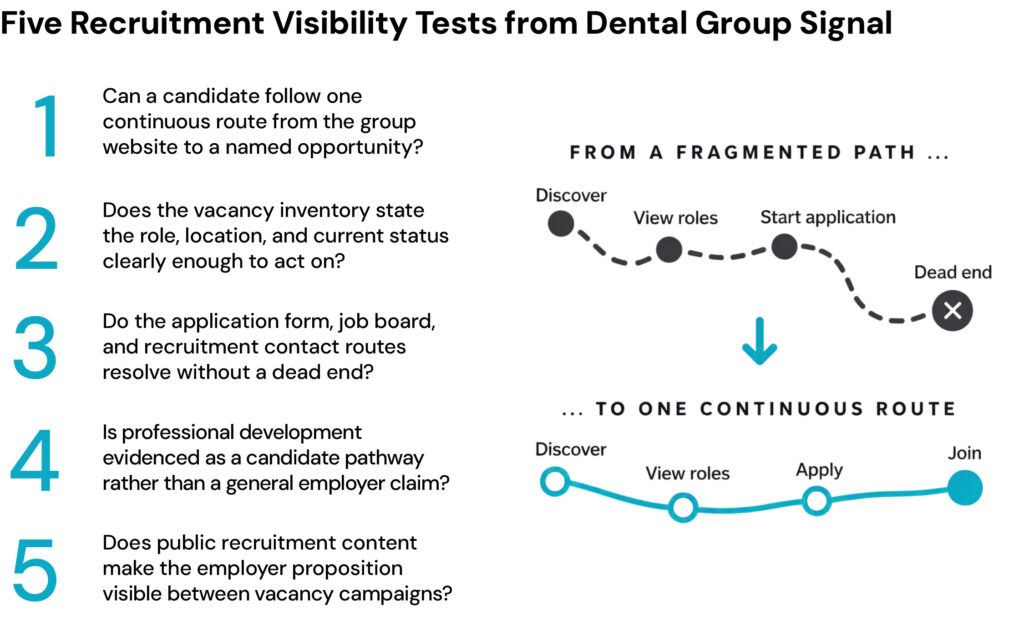
In both markets, the highest scorers share the same profile: live vacancies, a working application form, and a named development path a candidate can verify before contact.
Recruitment belongs on the growth agenda because candidates see the system before management sees the outcome. The public evidence gives boards something concrete to inspect now, rather than waiting for vacancy duration, agency spending, or chair utilization to reveal the cost later.
What the Benchmark Can Show
The benchmark tests what a prospective candidate can verify before making contact: whether a role can be found, whether the route to apply works, and whether the group makes its clinician proposition visible in public. It does not measure retention, pay, clinical standards, or the experience of working inside an organization.
The benchmark is a dated snapshot of publicly visible signals, not a permanent assessment. Any group in the cohort can request its own private score and evidence summary from Anthony Gedge at anthony@dentalgroupsignal.com.
Disclosure: Dental Group Signal developed and applies the Recruitment Visibility Benchmark.
Methodology note: Dental Group Signal’s Recruitment Visibility Benchmark v1.0 scores nine observable signals from 0 to 5. The raw total out of 45 converts to a score out of 100. Bands are Leader 85-100, Strong 70-84, Partial 55-69, Weak 40-54 and Low 0-39. The US snapshot is dated September 7, 2026; Signal 9 covered official LinkedIn company-page activity from June 10 to September 7, 2026, while logged in. UK comparison figures come from the published post-Q2 Enterprise and Mid-Tier editions measured in July 2026. Every published score is supported by dated public evidence.