
Every DSO leadership team I speak to has AI somewhere near the top of the list. The pitches are exciting, the demos are impressive, and there is pressure from every direction to be seen doing something with AI.
Buying is not the hard bit. Most groups can run a perfectly sensible procurement process. The hard bit comes 18 months later. In my conversations with DSO leadership teams, a meaningful share of what got bought hasn’t yet materially changed a number on the P&L. That matches the wider picture: MIT’s 2025 study of enterprise AI found 95% of pilots delivered no measurable P&L impact, despite $30 billion to 40 billion of spend so far.
I’ve worked as an ER doctor, as a management consultant to Fortune 500 companies at Boston Consulting Group, built a digital medical device company, and now run 01Health, building AI for dentistry.
Having sat on all sides of the table, these are the four questions I would ask. None of them is about pushing one technology over another they are about asking the right questions when buying AI for your specific office or group.

What Problem Are You Solving, and Would It Be on Your List Anyway?
Start with the outcome you want and work back to the tool. What I see so often is the reverse, with an impressive product looking for a use case to justify itself.
So ask yourself: If this vendor had never pitched you, would this problem be on your list at all? If the answer is no, FOMO is doing your procurement.

The next step for any dental leader is to appraise every solution, and not just the AI ones. Sometimes the answer is still a simple online booking link, a script, or a different schedule—at a fraction of the cost and without the ongoing management required by a complex AI tool.

Which Line of the P&L Does This Actually Move?
This is the question that most frequently gets skipped because the answer is often uncomfortable. Three promises get made constantly by vendors, and they sound great, but none of them produces ROI by itself. They may be enablers, but the metric-moving step is often still on you.
“More chair time back means more revenue.” Freeing up chair time doesn’t directly drive revenue; it only drives the bottom line if you fill the chair time with something else. For those of you with overflowing schedules and more demand than you can handle, extra chair time is definitely impactful, but if not, you’re just letting everyone go home early.
“Less time doing admin will save so much cost.” This is the most common pitch from AI vendors because so many are automating manual, back-office processes. Automation alone isn’t cost saving. Automation paired with a reduction in headcount is, or automation that lets you grow without hiring the next person. Either way, that is the uncomfortable truth people avoid discussing.
“People spending more time on what they love.” I’ve lost count of the times I’ve heard this across AI in all of healthcare. Investing in employee happiness is worthwhile, but unless it directly drives recruitment or retention, it won’t appear on your P&L.
None of that is an argument against buying AI tools—clearly, there are incredible AI products with enormous potential. What I’m arguing is that we need to be honest about which metric will change with this tool, project, or initiative. Is it revenue, cost, or employee satisfaction? And if you don’t know, you’re probably not going to move any metric.


Will Your People Notice the Difference in Time?
“Time to value” is the gap between signing the contract and the moment somebody actually notices the impact. It tells you more about whether a tool will still be in use in a year than almost anything else on your procurement checklist, but I rarely see it being discussed up front.
For example, take two tools, same price, same contract length. One writes a clinician’s notes for them: The consultation ends, and the note is already there. It feels like magic in the first hour of use. The other solves arguably a bigger problem; it produces a clean set of numbers across every site and does your accounts for you. However, it needs a year of data before anything useful comes out. The first person to feel its value is whoever closes next year’s accounts. That’s a long time before users see value from the tool.
Some of the most valuable things you will ever buy get worse before they get better because their value depends on data accumulating and on your people doing the hard work of changing their processes in the meantime.
So if that is what you are buying, be honest with your team. Tell them it will feel worse before it feels better, and tell them roughly when they’ll see the benefit. Nobody minds a hard first year if they were warned about it, but people won’t forgive being sold a quick win only to feel as though they are doing double the work for a year.
There is always a tipping point; if nobody has noticed anything by the time patience runs out, people go back to what they know, and winning them back is much harder than convincing them the first time around.
They probably won’t even tell you they’ve stopped using it. It shows up as a shadow process. How many of us have watched somebody keep a spreadsheet running alongside the new analytics platform the group just rolled out, or watched a group text quietly do the job the system was bought for? People keep a manual copy of anything they do not trust yet.
If You Switched It Off Tomorrow, Could You Prove the Difference?
Every vendor in dentistry will quote a number to demonstrate impact: “25% higher case acceptance,” “18× ROI,” “50% fewer no-shows.” Some of those numbers are real, but they were measured in somebody else’s practice, under somebody else’s conditions, usually by the vendor.
Whether the number is true is not really your question. Your question is whether the impact will be demonstrable in your practice, with your patients, after you have onboarded. So dig into how the number was built before you trust it, and decide how you are going to measure your own.
For example, a vendor’s ROI calculator might show $200,000 a year from a tool that flags more treatment on your X-rays. Dig into how that figure is calculated: Each flagged case is counted as $300 of revenue the moment it’s identified. Not once a dentist has diagnosed it. Not once the patient has said yes. Not once anyone has paid.
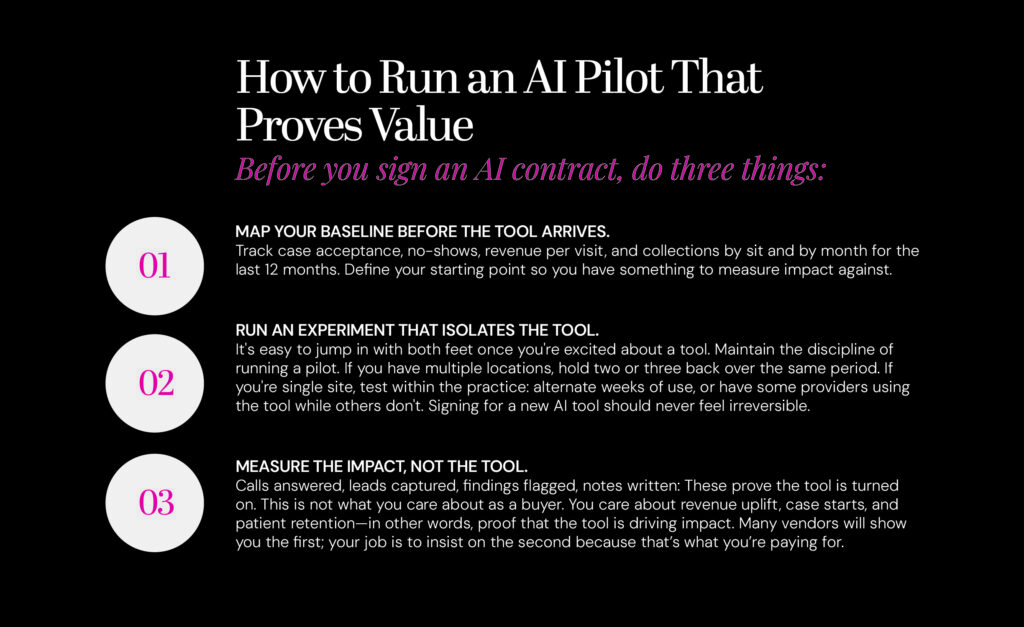
So the test is simple: Do completed case starts actually rise in the first 90 days of a trial? If you switch the tool off, do they fall away? You can run this yourself with a pilot: Isolate two or three locations, set your own baseline and your own goals, then track the results over a defined period. If a vendor pushes back on being tested this way, that tells you something.
In summary
None of this is an argument against AI—AI will transform dentistry. It is an argument for applying discipline to your procurement processes and not letting FOMO do the work.
Every question here comes back to the first one: If this vendor had never shown you this demo, would this problem be on your list? If the answer is yes, you will know which line of the P&L it should move, when your people should feel it, and how to prove whether it did. If the answer is no, FOMO is driving your procurement.