Hygiene is an important but often overlooked component
Over the past several issues of The LEAD, I have tried to give an honest account of where the DSO industry stands. In my 2025 year-end article, I called it “The Year of the Muted Recovery.” In my midyear update for 2026, I reported that conditions looked much the same. As I write this, not much has changed for the better. Interest rates have not come down in any meaningful way and may, in fact, be trending upward, as a deeply divided Federal Reserve strongly considered raising rates at its late July meeting amid continued global uncertainty and rising oil prices1. As a result, and unsurprisingly, the DSO M&A markets remain only slightly improved from a year ago. As of early September 2026, I am aware of a few more potentially significant DSO transactions that were attempted but have once again failed to close. Therefore, the recovery is still very much muted with no obvious end in sight.
What has changed is the conversation. I talk with DSOs, sponsors, lenders, and technology partners nearly every day. The question used to be, “When do the M&A markets come back?” Increasingly, the questions are, “How do we grow without them?” and “How do we build a premium organization that is not wholly reliant on the whims of the M&A markets?” Over the last four years, same-store growth has moved from a secondary talking point to the primary strategy for a large share of the DSO industry, and that is a healthy shift. Organizations that learn to grow from within during a muted market will be best positioned to recapitalize when the M&A markets finally improve. Something that needs to be said out loud is that in these extremely challenging market conditions, not every DSO is guaranteed a recapitalization event. The premium organizations that differentiate themselves from the rest of the pack stand the greatest chance of reaching a satisfactory or better recapitalization event.
When I am asked where same-store growth actually comes from, the answer often involves the integration of the many new, innovative technologies, often involving AI. Indeed, the last five years have heralded the Age of Dental Innovation, with more advancements in the last five years than in the previous 100 years. Adopting technology is no longer optional. It is an essential component of building a premium organization. However, as the DSO industry explores the various available technology solutions, I can’t help but notice that the proper implementation of hygiene (a tried-and-true solution with many years of favorable case studies) is often overlooked as a driver of growth. In fact, it has been a very long time since I have written or presented about hygiene, so I turned to my friend Heidi Arndt, Founder and CEO of Evolve Dental Advisors and one of the leading authorities on DSO hygiene programs, and asked her to collaborate with me on this article because it is time to revisit hygiene as an important component of a premium DSO organization and an important driver of growth.
When done correctly, hygiene is the department that keeps patients connected to the practice, feeds the doctor schedule, and drives diagnosis and treatment. It is also the department most DSOs still evaluate as a single line item on the P&L.
Understood correctly, hygiene is not a line item. It is the engine for the rest of the practice, and the largest same-store growth opportunity most organizations already own but have never fully measured.
That is why I asked Heidi to write the portion of the article that follows. Heidi has spent more than two decades on every side of this issue. She started chairside as a dental hygienist; rose to National Director of Dental Hygiene at American Dental Partners where she oversaw hygiene performance across more than 250 practices and 1,000 hygienists; built and sold a hygiene consulting firm that served DSOs nationwide; and later ran a private equity-backed DSO as CEO through a successful sale. Few people in our industry understand the economics of hygiene from the operatory to the boardroom the way she does. She lays out, better than I could, why a modest per-practice improvement in hygiene becomes a material enterprise value number at the DSO level and why the usual approach of simply demanding more production is the wrong starting point. I encourage every DSO leader to read it closely, then go look at their own hygiene numbers with fresh eyes.
The Same-Store Growth Engine Hiding in Plain Sight
Why DSO leaders should rethink the enterprise economics of hygiene.
For years, growth in the DSO market has been synonymous with acquisition: add practices, add providers, enter new markets, grow the top line. That instinct has been harder to satisfy in a deal environment well below its prior highs.
That is exactly when a different question deserves equal weight: How much growth is already sitting inside the practices a DSO already owns? It doesn’t depend on interest rates, deal multiples, or when the M&A market reopens in force.
Hygiene looks different depending on where you sit. From the advisor’s seat, it shows up as an underperforming line item worth investigating. From the CEO’s chair, it shows up as a scheduling and staffing problem worth solving. Seen from either vantage point, one thing holds true: When hygiene underperforms, the financial impact travels far beyond the hygiene schedule.
The Economics Are Bigger Than Hygiene Production
When hygiene is evaluated solely by the number in the hygiene column of the P&L, its real contribution to the business is consistently understated.
Hygiene is the channel through which patients continuously move through a general dental practice: returning for preventive and periodontal care, triggering doctor examinations, and surfacing treatment needs. Hygiene capacity leads to patient access; patient access enables clinical care and diagnosis; and diagnosis leads to treatment and recurring revenue. Cut the flow anywhere in that chain, and everything downstream slows with it.
A hygiene capacity problem is rarely just a hygiene revenue problem. When a practice cannot accommodate its existing patient base, it loses the examination, the diagnosis, and the relationship that follows. In one practice, that loss looks small. Across 20, 50, or 100 practices, it adds up fast.

The Hygiene Flywheel
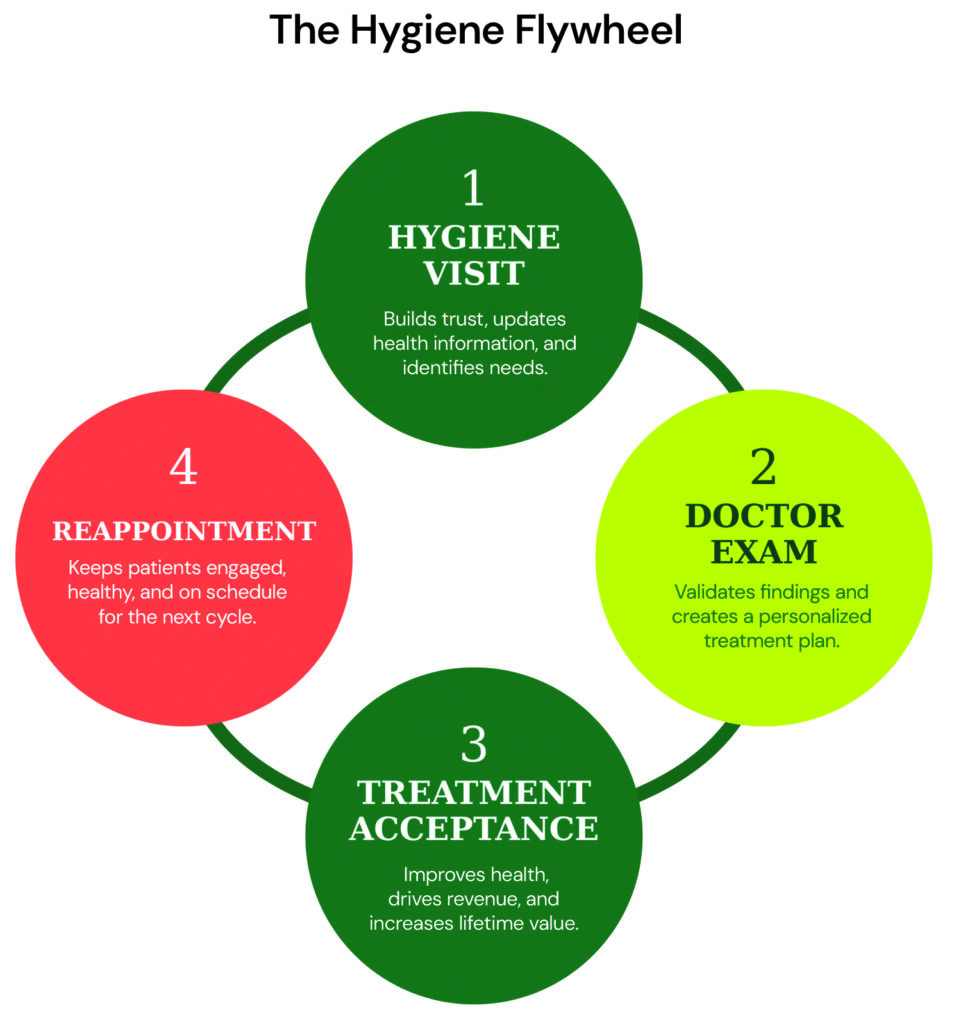
That chain is really a flywheel, not a one-time transaction. A hygiene visit doesn’t just generate a single unit of revenue; it generates a patient who is scheduled to return in six months and who, in the meantime, has had an exam, a diagnosis, and, when appropriate, a treatment plan. Each turn creates the conditions for the next one: The reappointment books the next hygiene visit, the hygiene visit triggers another exam, the exam leads to diagnosis and treatment, and a well-cared-for patient stays attached to the practice, ready to turn the wheel again.
That’s what makes hygiene a different kind of growth lever from most others. A marketing campaign or new-patient promotion has to be paid for and relaunched every time an organization wants another cycle of growth. A functioning hygiene flywheel doesn’t; it runs on patients the organization already has, generating recurring visits, exams, and treatment opportunities without new spend behind every cycle.
The flip side is just as real. A flywheel losing energy doesn’t stop all at once; it slows quietly. A patient leaves without a reappointment. An exam is skipped because the schedule is behind. A treatment plan is diagnosed but never presented. None of these registers as a single dramatic loss.

They show up as a little less momentum, repeated across thousands of patient visits and dozens of practices, until leadership looks up and finds the hygiene number, the new-patient number, and the production number have all quietly drifted down together. That’s why each step in the hygiene flywheel matters: Together, they keep the wheel turning rather than winding down.
Small Improvements Become Enterprise-Level Growth
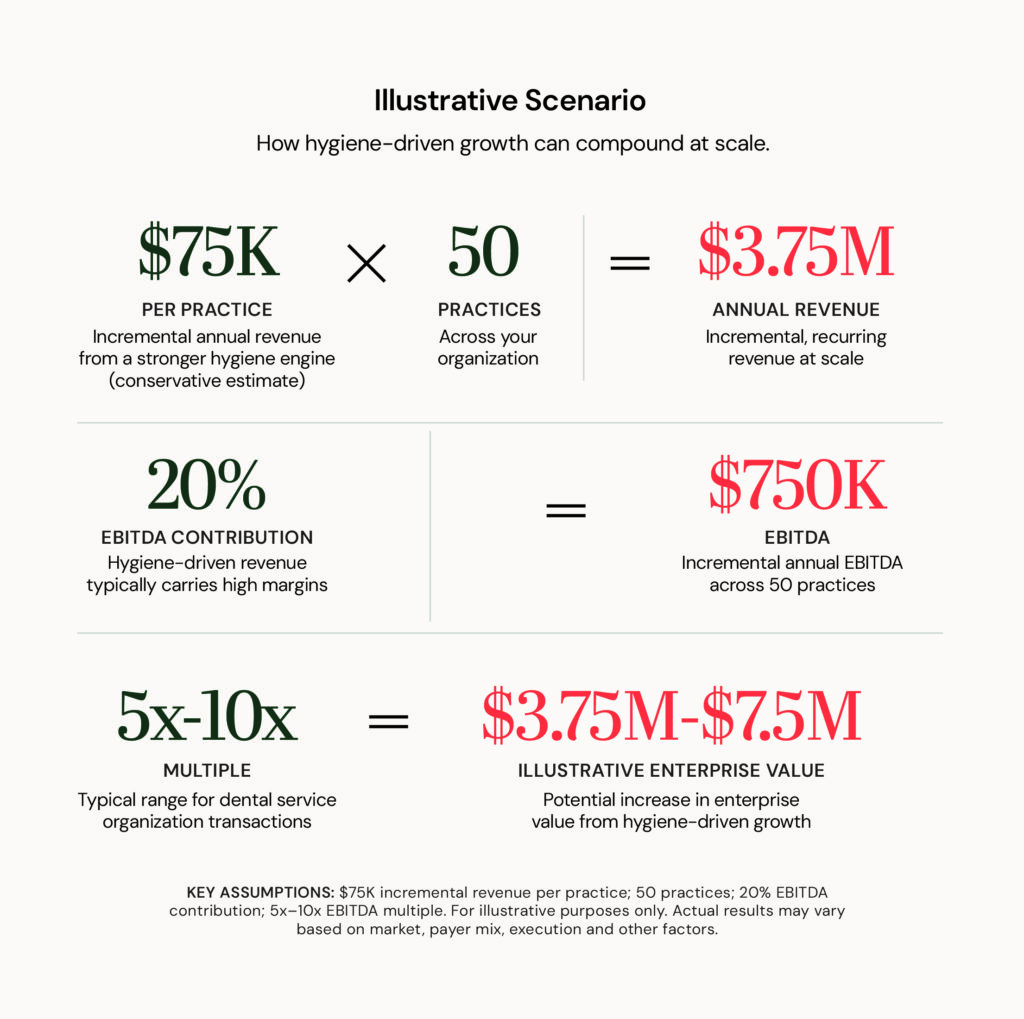
Consider a 50-practice DSO that lifts annual hygiene revenue by $75,000 per location—a realistic, not aggressive, improvement. That is $3.75 million in incremental annual revenue. If $750,000 of it flows through to EBITDA, that is meaningful growth generated entirely from the existing practice base, without acquiring a single location. At a representative DSO transaction multiple, that EBITDA increment alone can translate into several million dollars of additional enterprise value, created without an acquisition or a dollar of goodwill paid to a seller.
And that math only counts the direct hygiene revenue, not the downstream effect of more patients moving into the doctor’s chair or the compounding effect of a flywheel that keeps those same patients returning year after year. Modest improvement at the practice level becomes a very large number once it’s multiplied across an enterprise and compounded over time. That’s the mechanics of same-store growth, sitting inside every DSO right now.
The Wrong Question Is “How Do We Make Hygiene Produce More?”
When hygiene falls short, most organizations start with production: more visits per day, shorter appointments, added assisted hygiene, different compensation. Those may be legitimate levers, but they are rarely the right starting point. The more useful question is: Where is the growth actually being lost?
Across dozens of organizations, the hygiene opportunity is almost always visible, and the cause is almost never the same twice. Sometimes capacity is genuinely insufficient; sometimes it exists but is poorly utilized.
Sometimes the clinical mix does not match patient needs, patients leave without their next appointment booked, or compensation no longer works. Sometimes the model is sound, but doctors, hygienists, and regional operational leaders were never truly aligned around it. These are different problems requiring different solutions. An enterprise hygiene strategy can’t just be a single production target handed down across dozens of practices.
Stop Looking for One Hygiene Number
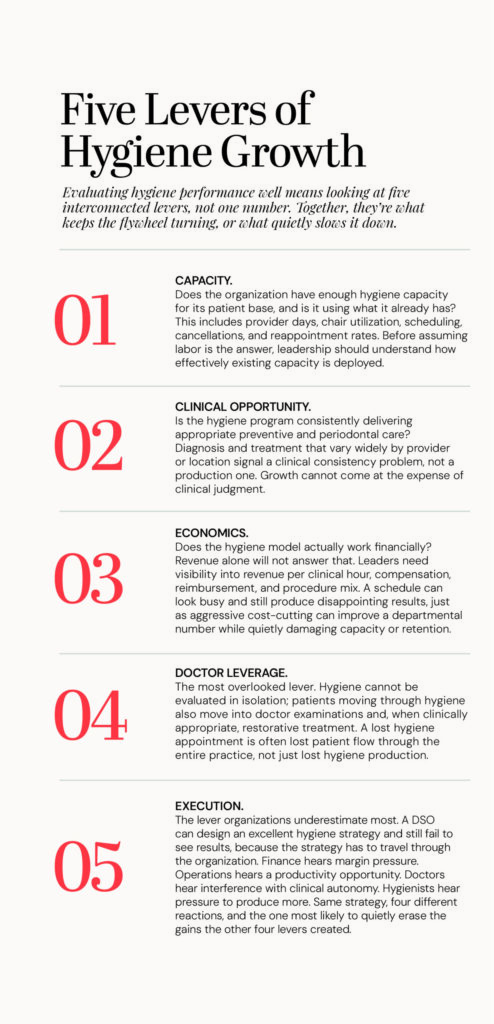
DSOs naturally want a single benchmark for hygiene performance. It’s a reasonable instinct, and it doesn’t work. No single percentage will ever tell the whole story. A sophisticated enterprise view examines capacity, clinical care, economics, retention, doctor leverage, and execution together, and accepts that the diagnosis will look different from one practice to the next. The job of enterprise leadership is to set the operating principles and guardrails, then let the organization diagnose what is actually limiting performance locally.
Before You Buy the Next Dollar of Growth
DSOs will keep acquiring practices when the market allows it, and they should. But same-store growth does not wait for favorable financing or a more active deal market. It is available now, inside every practice already on the platform. Before looking outside the organization for the next dollar of revenue, it’s worth taking stock of what’s happening inside the practices already owned: How much hygiene capacity exists, and how much of it is actually used? Are patients staying connected to the practice? Does hygiene support doctor productivity the way it should?
Hygiene has always mattered to dentistry. What’s changed is the scale at which DSO leaders should be thinking about it and the urgency of the environment surrounding that thinking. In a single practice, improving hygiene performance creates meaningful growth. Across a 50- or 100-practice organization, it creates meaningful enterprise value, the kind that shows up on a valuation model regardless of where the acquisition market stands.
In a market still waiting on its next wave of deals, hygiene may be the most powerful flywheel a DSO already owns—one that, once turning, keeps generating growth long after the initial push.