The Next Advantage Isn’t Margin—It’s Innovation
By Dr. Greg White
As leaders, we wake up every day trying to move things forward—teams, communities, organizations, and sometimes entire cultures. High ambition creates a wild ride. And if you’ve been anywhere near dentistry over the past five years, you know the ride hasn’t exactly been gentle.
I’ve always loved a line from one of my favorite storytellers, Jimmy Buffett. He wrote about a friend who “went to Paris looking for answers to questions that troubled him so.” Jimmy asked him, “Did you find the answers?” And the friend replied, “There are no answers, but the search generated a lot of interesting stories.”
That’s leadership. That’s business. That’s dentistry right now. We may not have found all the answers we expected to find in the last half-decade, but if you’ve been in the arena, you’ve generated plenty of interesting stories.
The Market Matured—and It Changed the Rules
For a long stretch, the DSO industry was dominated by efficiency: cost control, scale, systems, margin management, and standardization. The “machine” got built, and a lot of organizations built it well. But the market matured.
Efficiency used to be differentiation. Now it’s table stakes. It’s no longer the trophy; it’s the admission ticket. It’s the ante to stay in the game.
And when the chairs are arranged and the music starts up, the organizations that win won’t be the ones who can only cut costs. They’ll be the ones who can build value.
Because profitability in the next era will be fueled by innovation and engagement, not just margin management.
Some Entered the Theater Looking for the Exit
Here’s a picture that keeps coming back to me: No one enters a movie theater looking for the exit. You don’t walk in, sit down, and think, “How fast can I get out of here?” Your mind is focused on the story unfolding.
Yet many in our industry-built cultures centered on the end scene, not the experience of the film. They optimized everything around the exit (around the equity event) and around the final score. Monday-morning quarterbacking is always easier than game day, but in retrospect, we can make a case that this was predictable.

Post-pandemic fear accelerated consolidation, and valuations climbed. Pipelines became a flex. Differentiation among DSOs was used to attract affiliate doctors. Healthy pipelines attracted investors. The deals were made, and the clock began ticking.
For affiliate doctors: retirement timelines.
For investors: return timelines.
For leadership teams: performance timelines.
And most in our industry—whether we admit it or not—became aligned around one finish line: the next equity event.
Then the predictable part arrived. Inflation emerged as a result of federal cash infusion in the US economy. Interest rates increased. Global unrest continued. Regulation tightened. And suddenly, the market that had been sprinting hit the kind of fatigue that makes even optimistic leaders start looking for the water table.
And for many groups, there was no contingency plan because the strategy was the exit. Arbitrage was the plan—the only plan.
Which brings us back to that movie theater. If you enter the theater looking for the exit, why would you care about the quality of the film? Culture suffers. Innovation dies. Engagement evaporates. And when the leaders are disengaged, the team can smell it. They can smell the BS.
The Human Capital Blind Spot
Here’s what I believe we overlooked, but that the right leaders are uniquely positioned to correct:
We optimized processes more than potential.
We treated talent like labor—not like leverage.
Leaders know people matter, but many DSOs don’t have systems that turn human potential into enterprise value. For the past two years especially, many poured energy into creating efficient systems, and by and large, failed to unlock the human capability sitting inside those systems.
And the truth is, the skill sets required now have changed.
This next era is going to reward organizations that invest in people who can think strategically, solve problems, innovate, and lead through ambiguity.
The next strategic advantage isn’t another layer of reporting or another dashboard. It’s unlocking the full potential of your people.
Profit Follows Engagement (and Disengagement Is Expensive)
Engagement is the number-one predictor of profitability. And yet, if we’re honest, most teams in the dental industry have lived through an extended stretch of uncertainty, burnout, and emotional whiplash. Disengagement shows up quietly at first: slower adoption, less ownership, more turnover, more drama, more excuses, less creativity.
And disengagement is expensive: financially, operationally, culturally.
Private equity–backed DSOs often unintentionally train doctors and leadership teams to think in “exit math.” When every early conversation starts with “Here’s how you’ll get paid at the next event,” it’s hard to build a culture that wakes up fired up about Monday.
So what if the mindset shifted from “One day we’ll cash out,” to “What value are we building now?”
Who we partner with matters. And the stage for a great partnership is set by expectations.
When affiliate conversations begin with exit math, there’s little motivation to engage in the behavior change required to build a winning culture. Achieving a desired final score without a game plan is as effective as a budget without a business plan.
Rethink Incentives: Align to Daily Value Creation
Dentists don’t wake up excited to contribute to EBITDA. They wake up excited about impact, pride, autonomy, excellence, patient outcomes, team culture, and, if you selected well, contribution. We have to be cautious of dentists whose primary goal is to exit the chair. Someone has to do the work. The doctors you want get excited to contribute to the mission. So, make it worth their time.
The current state in many DSOs is that providers and teams are aligned to liquidity, not daily value creation.

The future state has to look different:
- Align compensation with innovation, inspiration, and culture.
- Align recognition and decision-making to performance in the present, not just the promise of a payout.
- Avoid tying everything to financial metrics alone, because when you do, you’ll create a tyranny of the urgent at the expense of what’s truly important—and morale will suffer.
Great organizations cling to purpose—not people. We should focus on the humble, hungry, and emotionally smart. Thinkers. Builders. And prune away the disengaged and arrogant. Because in a tighter market, we’re competing for a limited number of chairs.
This Is Where Leaders Step Up
This is the time for leaders to step up.
If we stop anchoring everything to the exit, what innovation might our doctors and teams feel permission to pursue today?
Differentiation is now measured in terms of leadership and innovation. This is critical at both the office level and the enterprise level.
Many founding doctors built something of great value with their teams. The practice isn’t just a P&L. The doctor and the team are the practice, built on decades of trust and relationships. And, that value only transfers well through a carefully planned transition. It takes clarity, cooperation, planning, and time.
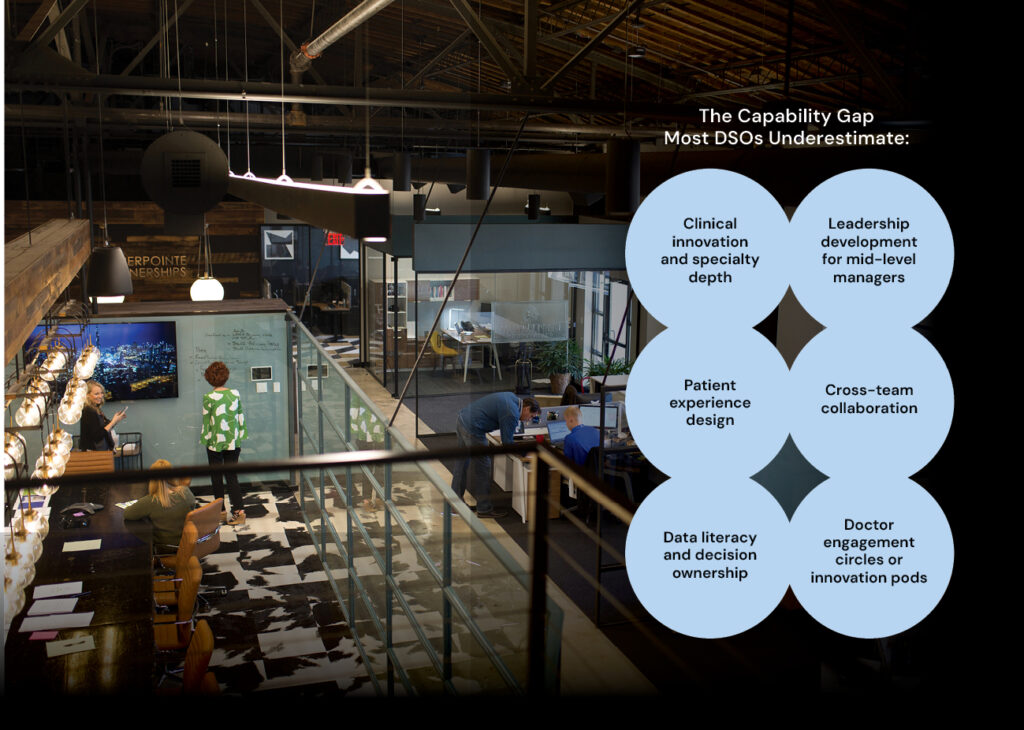
The Capability Areas DSOs Can’t Ignore Anymore
Capability, motivation, and innovation will take us further. And all of it requires discipline—the same discipline that built great practices in the first place. Because without discipline, we become prisoners of our bad habits and we get the results we deserve. Bad habits, at first, are like chains—too light to be felt. But in time they become too heavy to be broken.
The Capability Ladder: How to Unlock What You Already Have
If we’re playing to win, let’s access the team we have.
First: Know your people.
Map strengths, interests, and hidden expertise. You’ll be shocked what you discover when you stop treating job titles like identity.
Second: Activate teams.
Give them ownership over solutions and ideation. People engage with what they feel part of.
Third: Build shared language.
Common language around goals, service, growth, and behavior.
Simple shared frameworks can create alignment faster—lean into what you think will resonate most with your team.
Fourth: Invest in skill growth.
Don’t invest just in CE, but invest in leadership, innovation, and strategic thinking, such as AI-driven leadership training, EI workshops, and staff development days. Make it a deliberate practice around how to think—not just what to do.
Not all people seek to be inspired, but some do. And all people are attracted to optimism and energy when it’s authentic and has substance behind it.
Which brings us to the true job description of leadership.
Innovation Isn’t a Department—It’s a Culture
Your team doesn’t want to sit in the audience. They want a role in the story. So, leaders must create environments where ideas are not just welcomed but expected.
Innovation is not a department. It’s a culture powered by clarity, permission, and collaboration.
And the advantage will favor those who create that culture.
If you want to boil human innovation down to three levers, here they are:
- Provide clarity: paint the picture. Make the plan understandable.
- Give agency: permission to act, permission to try, permission to fail and learn.
- Offer recognition: celebrate visibly and often. Praise in public. Correct in private.
Be open, honest, and transparent with your key team members. Train them and let them go. Let them fail, learn, and succeed. People who are going nowhere can take on no fellow travelers. If you don’t paint a clear picture of where you’re leading, you’ll look behind you and see no one.
And be clear in communication. Most relationships are lost in the gap between what is said but not meant— and what is meant but not said.
A Mantra for the Next Era
We’re moving into an era where we must wage war on complexity. Simplify systems. Streamline operations. Hire talent. Lease expertise when needed. Invest in people who can build, not just maintain.
And most of all, stop building cultures centered only on the end scene.
Because the story matters. The experience matters. The way value is built day after day matters.
So here’s a mantra I believe the winners will live by: We don’t just optimize. We originate.
Innovation must lead. We need to create the environment where the thought can live, grow, and turn into action. That requires top talent, disciplined leadership, and a culture of engagement.
The music is starting up again. The chairs are limited.
Let’s make sure we’re not just trying to sit down.
Let’s make sure we’re building something worth standing for.

Dr. Greg White serves as the president and CEO of PepperPointe Partnerships, and is one of the founding partners of White, Greer and Maggard Orthodontics (WGM). WGM formed in 1991, and is currently part of one of the largest, privately-owned pediatric and orthodontic group practices in the country. Prior to leading PepperPointe’s significant growth, he actively practiced orthodontics for more than 25 years.