DR. RANIA SALEH IS ON A PERSONAL AND PROFESSIONAL MISSION TO UNITE THE CLINICAL AND BUSINESS SIDES OF DENTAL PRACTICES IN ONE SOFTWARE PLATFORM
In the early 2000s, newly minted dentist Dr. Rania Saleh faced a dilemma: she knew how to be a great dentist, but she found herself in an environment where it was almost impossible.
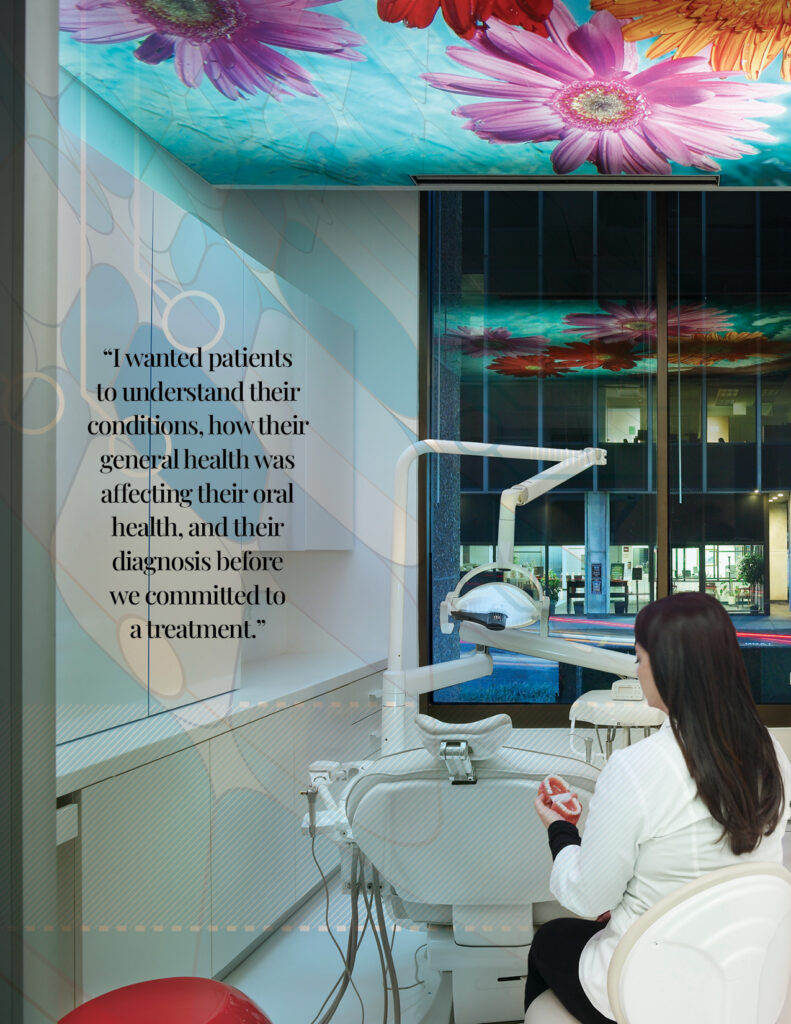
“I was working in an extremely busy practice as an associate, and I couldn’t continue the way that practice demanded, knowing that there was a better way to do it,” she says. “I wanted patients to understand their conditions, how their general health was affecting their oral health, and their diagnosis before we committed to a treatment.”
So, Saleh struck out on her own, ready to do things her way, opening a practice near Washington, DC. But even after opening her own cosmetic dental office and implementing an in-depth, diagnosis-focused approach to examining and treating patients, she found that the available dental software on the market was more hindrance than help, particularly in terms of getting her entire team on the same page when doing examinations.
Saleh knew technology could empower dentists to better serve their patients with enhanced clinical care and education. She also knew she had a Kois Center-inspired examination protocol that worked, and that modernized technology could only make it better.
Guided by an undaunted attitude informed by a childhood shuttled between war-afflicted Lebanon and Canada, a strong belief in her own abilities, and an extensive knowledge of the dental industry, Saleh decided she could create what the industry lacked. In 2016, she founded Oryx Dental and began developing the platform, starting with her clinical approach to patient exams.
The vision behind Oryx is clear and direct: give dentistry the technological support and innovation it has lacked for so long—and watch the industry reach its full potential.
Dental Health Is Healthcare
Saleh developed the detailed examination protocol she would later apply to her practice and to Oryx after she was introduced to the Kois Center and completed the program in Seattle. The Center’s comprehensive, evidence-based methodology upended her view of traditional, procedure-based dentistry. It also posed a fundamental question in terms of treating patients.
“Would dental patients have the patience for an exam that might stretch to hours if they knew it would significantly improve their outcomes?” she recalls asking herself.
Indeed, she discovered, they would.
As Saleh’s private practice in DC rapidly grew and her patients embraced extensive, detailed exams and information, Saleh started getting feedback on her somewhat unusual methods.
“I would get calls from the GI department at Georgetown,” Saleh says. “They’d say, ‘Thank you so much for referring these patients. We were able to discover early cancers. We didn’t know that dentists could find these things.’”
The Kois Center-derived approach was working. As her thriving practice grew to two locations, Saleh hired associates to meet demand. But when she became pregnant with twins and was put on bed rest for five months, her associates were unable to maintain the standard of care and the business suffered.
Saleh found herself at a crossroads. The bed rest finally gave her time to reassess her strategy and revise her exam protocol, which she began teaching in earnest to her associates to try to boost her practice. Still, she couldn’t be in the clinic looking over their shoulders.
At this point, she started discussing with her husband, an engineer for a healthcare IT company, how she could duplicate the exam protocol using software. Clearly, there must be a better way to get consistent results through technology, even if dentistry had yet to discover it.
That’s when the beginnings of Oryx Dental went from concept to reality.

Putting Clinical Care at the Core of a Broader Platform
“There was no clinical component at all,” Saleh says of dentistry software back in the day. “You could complete an exam by just writing two lines, or by entering a few data points. Nothing was guiding the dentist to go through a very thorough process.”
Dentists also juggle marketing, billing, and business management alongside clinical work, often falling back on manual, disconnected processes just to get things done. Previously, the software available to help with those tasks was neither integrated nor efficient. In terms of pace and pizzazz, the existing solutions were like a horse-drawn carriage.
“There were a lot of workflow inefficiencies in the software on the market in 2016,” Saleh says. “Software functioned more like different data entry points that you had to put together, and the output was not a treatment plan but just a procedure code and a price.”
Saleh envisioned something precise and responsive—a sports car instead of a carriage. Thinking of systems used more broadly in healthcare, she set out to develop a platform that both drives clinical evaluation workflows and improves the efficiency of those workflows.
Conceptually, the solution also had to be a fully integrated platform that included messaging, scheduling, billing, and other front-desk functions automatically generated by a triggering event like the completion of a patient exam.
“Oryx is about having an amazing workflow from start to finish, making sure you’re delivering the best clinical care, and, on the business side, taking care of everything you need to,” says Saleh.
It’s been more than a century since horse-drawn carriages were considered advanced technology. Perhaps it’s time to stop thinking that the software equivalent is useful.
Smarter Providers and Patients
“My goal has always been to empower dentists and also to empower patients—and to create an amazing relationship between them,” says Saleh.
As the starting point for her clinical protocol, Saleh relied on the Kois Center’s foundational four-part examination methodology: gum health, condition of teeth, bite and jaw joint, and overall smile.
“You assign a risk in each area, so when you explain the patient’s dental health to them, they understand the risks involved,” Saleh says. “Patients really liked that, even though it was time-consuming.”
Indeed, this clinical approach is what makes Oryx a unique platform that elevates the way dentistry is practiced. Saleh highlights the educational materials the system makes readily available to providers at the point of care, which are updated regularly.
These materials drive the thorough and detailed explanations patients receive during exams, which increase engagement and understanding. That improved understanding, Saleh emphasizes, is the product of a system that looks at the big picture and focuses on the confluence of factors that impact overall health.
“Traditionally, dentistry has been procedure-focused, at least in part because of how insurance is paid.” Saleh explains. “Dentists become conditioned to look for problems rather than looking at the patient’s general health. Oryx enables them to see the full picture.”
7 Minutes to Better Heath
Dental providers need effective software to improve clinical performance and patient satisfaction.
Consider how Oryx uses images to ensure that both the clinician and the patient clearly see what’s happening. Where dentists have typically used a digital SLR to take high-quality images, Oryx supports an iPhone app to take photos that go straight into the chart.
“We saw compliance skyrocket in data collection with the introduction of this app,” Saleh says. “And users are saying the reports generated for patients have more value with the photos.”
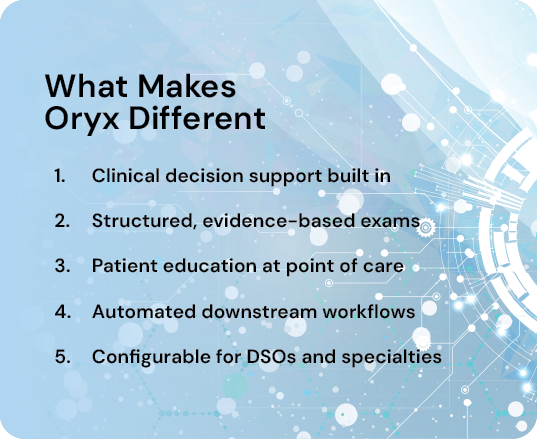
Of course, a busy dental practice still doesn’t have hours for each check-up, as Saleh originally envisioned the ideal patient examination. In developing Oryx, and in working with John Kois, Saleh and her team have created a standard, templated exam that incorporates the Kois Center’s evidence-based treatment protocols and employs clinical decision support.
“There’s a very structured exam,” Saleh says. “It takes about seven minutes to do on any patient, and this is the best seven minutes you can spend. When you’re done with the exam, the next steps for diagnosis and treatment are clear.”
That Oryx can support a diagnosis after seven minutes is in part enabled by how the platform can be configured for specific practices and patient bases. For example, Oryx includes pediatric exams, questionnaires, and photos; prompts for questions about fluoride; and unique workflows to accommodate specialty practices.
“What we wanted was to be able to focus on just the clinical stuff that simplifies everybody’s life and makes things easier for patients,” explains Dr. Christopher Baer, a Colorado clinician and Oryx user. “We’ve seen a dramatic improvement in case acceptance because of the way that we can present the information.”
Better Tools, Better Dentistry
As with health care generally, software as a service (SaaS) and AI innovations are key to bringing the dental industry up to date in terms of what is technologically possible.
Because Oryx is implemented using a SaaS approach, the platform can be segmented to meet the needs of multioffice practices or DSOs with multiple locations. The SaaS model also eliminates the need for on-premise data centers and makes future expansion to accommodate growth a simple process that negates local data center demands and requirements.
What will really enable dentistry to evolve from the antiquated technology of just a decade ago to the cutting-edge potential of now is AI and the functions it makes possible, such as ambient listening and image scans.
“It’s going to make clinicians and front-office workflows a lot more efficient,” Saleh says, “but most importantly, it is going to improve the patient experience. Clinicians in our offices who use AI tell us, ‘I can look the patient in the face. We can have a conversation.’ I think dentists and patients will have a much better relationship once all the clutter is gone.”
Oryx objectively represents a leap forward in an industry that has relied on old-fashioned legacy software for decades. Just as hospitals and clinics made the jump to the digital age two decades ago, dentistry is having its own digital moment now.
“Dentistry has been underserved by software for decades,” Saleh says. “Some offices were reluctant to adopt certain tools because the benefit was not clear, but when software is clearly built for specific purposes and provides documented benefits, the decision is much easier to make.”
The Future of Dentistry Is Now
Saleh knew dentists and patients deserved better, and she had the confidence to believe she could deliver. From more consistent protocols to better education to more structured exams, Oryx enables dentists to practice in a way that is a huge leap forward from even a few years ago.
And the practices that have moved to Oryx have quickly noticed the business benefits and improvements to patient treatment.
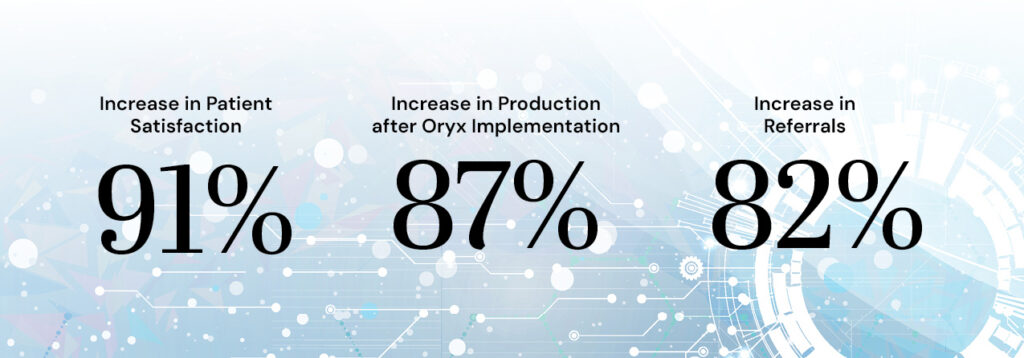
“We had a DSO that moved to Oryx, and they doubled their production in one year,” Saleh recalls. “Their case acceptance and referral rate more than doubled because they had this consistency. It didn’t matter if it was the lead doctor or the new junior doctor seeing a patient. Everyone was doing the same exam, everyone was doing the same treatment plan.”
The funny thing about the future is how hard it is to know when you’re in it. Appreciating the difference between a horse-drawn carriage and a sports car, however, is very easy. Saleh is confident that dentistry can recognize this significant moment—that now is the time for groundbreaking change— and appreciate the increase in velocity.