
A Strategic AI Fix for the Dental Front Office
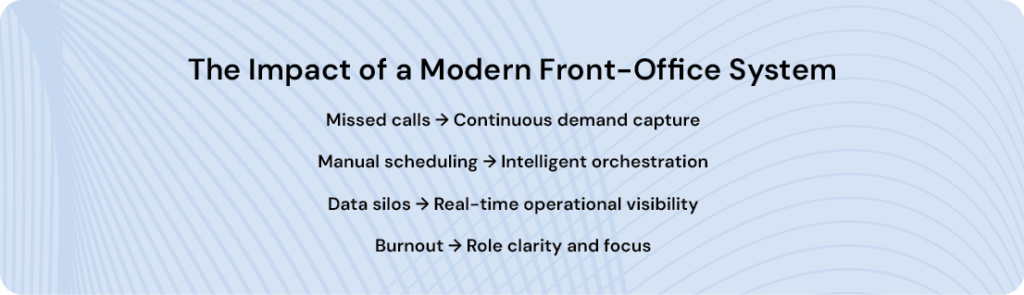
Dental organizations are not facing a staffing problem—they are facing a systems problem. Rising labor costs, fragmented technology, and escalating patient expectations have pushed the traditional front-office model beyond its limits. The next phase of DSO performance is not defined by hiring more people, but by redesigning how work gets done.
Here, we’ll explore the three reasons why your solution is implementing a modern dental front-office AI platform that helps streamline operations, capture more revenue, and deliver an exceptional patient experience across your DSO enterprise.
01
The High Costs of Static Staffing
According to Dental Protection, nearly two-thirds (63%) of dental professionals report frequent feelings of burnout and exhaustion. If daily administrative tasks stretch your front-office staff to their limits, practices are at increased risk of costly errors, service oversights, and even employee turnover. And what does this mean for peak times and seasons when performance pressures hit overload?
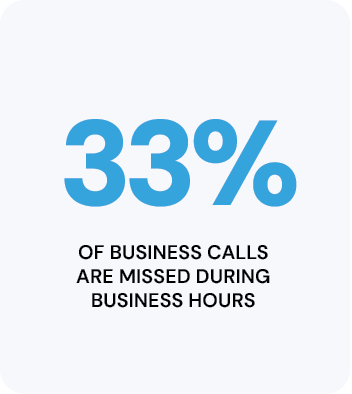
- Quantifiable Opportunity Loss: Dental practices miss one out of every three calls during business hours, notes an article in Group Dentistry Now, with 65% of those being potential new patients.
- Loss of Patients to Competitors: When there’s no system to capture missed or after-hours demand, callers may contact competing practices with the capacity to accommodate them.
- Negative Customer Experience: Consider how patients’ perception of long wait times and distracted in-person service at the front desk may negatively impact their confidence and trust in the practice.
It may appear that adding headcount is the best (or only) answer to ringing phones and lines of patients at the front desk. But take into account the principle of diminishing returns—productivity will yield to inefficiency quickly if existing technology and workflow issues aren’t addressed. Process bottlenecks will continue to slow everybody down and potentially become more pervasive. They’ll also thwart opportunities to attract, serve, and retain patients.
Altogether, a front office that isn’t running optimally can’t be expected to support growth. And adding more people isn’t guaranteed to impact productivity and profitability metrics that matter to scaling DSOs.
The Systems Fix: A comprehensive AI-powered front-office platform will arm your DSO’s practices with 24/7 call and scheduling support functionality that’s inherently scalable—and always there for patients when they need them:
- AI receptionists capture and qualify patient demand 24/7; convert missed calls into scheduled revenue.
- AI assistants/co-pilots automatically transcribe voicemails and compose first-draft emails, prioritizing high-importance messages.
- AI sentiment analysis tools provide real-time insights into patient sentiment and call intent so that when staff take a call, their interaction is targeted, proactive, and genuinely empathetic.
These capabilities help eliminate administrative overhead, enhance the patient journey, and drive revenue. They also directly benefit staff members, who are free to spend more quality time on higher-value patient interactions.
02
Fragmented Technology Impacts Performance
The front-office tech stack in many practices has become a patchwork of individual “point solutions” for marketing, scheduling, insurance verification, and reputation management that rarely communicate with one another. While these tools are intended to help, their disparate systems create data silos and disjointed workflows. Staff pays the price, jumping between multiple applications and manually entering data and reconciling information.
Aside from piling more work onto your staff’s plate, this approach results in operational blind spots and missed revenue opportunities. In this reality, it’s almost impossible to gain a holistic view of the practice’s health or to proactively manage the patient lifecycle. Introducing more people to the situation would only complicate, not streamline, the tangled web of tech.

The Systems Fix: To truly maximize efficiency, practices must move toward a unified technology strategy where systems are deeply integrated rather than just “adjacent.”
When AI has a deep connection to your data, it becomes an intelligent administrative partner enabling you to:
- Eliminate Administrative Friction: By automating routine tasks like scheduling, follow-ups, and data entry directly within the PMS, AI removes the heavy lifting from your front-office team.
- Leverage Actionable Patient Data: Connected systems ensure that every piece of patient information is available to power a more responsive patient experience.
- Maximize Revenue and Conversion: Integrated AI monitors the entire patient journey in real-time, ensuring no opportunity for practice growth falls through the cracks.
- Streamline Clinical and Business Operations: A unified platform provides a “single source of truth” via dashboards that offer real-time insights into booking rates, handle times, and production trends.
For organizations aiming to optimize ROI, the focus must shift to unified AI platforms. These solutions move beyond simple automations by integrating directly into your tech stack, optimizing every patient interaction and maximizing overall practice efficiency.
03
Patients Expect Speed AND Empathy, Not a Tradeoff
Staff can’t “go it alone” if they want to provide patients with the 24/7 service they expect. Unfortunately, outdated processes and limited access windows create a service gap that makes hightouch, personalized service nearly impossible to scale.
The trick is finding the right balance between tech-driven convenience and human empathy. While AI is engineered for superhuman speed, purely digital interactions can feel cold and transactional, stripping away
the human element that builds clinical trust. This tension prevents many DSOs from fully committing to automation.
The statistics tell a clear story of this conundrum:
- The Human Preference: An overwhelming 93.4% of consumers still prefer interacting with a person over AI for service needs.
- Technology As Table Stakes: 79% of patients want the ability to use technology when managing their healthcare experience.
- Yes, and …: 88.8% of consumers believe companies should always offer the option to speak with a human.
The problem isn’t the technology itself— it’s the lack of a system that knows when to step in and when to step back.
The Systems Fix: Rather than forcing a choice between speed and soul, a unified AI platform enables a hybrid service model. Think of it like a self-driving car: The AI handles the simple routing and lane-keeping, but a human driver is always ready to take the wheel during complex, high-speed, or emergency situations.
By strategically aligning tasks based on risk and complexity, DSOs can achieve:
- Workflow Optimization: By letting AI handle routine, low-risk transactions, you satisfy the demand for speed when patients need it most.
- Intelligent Handoffs: If a patient expresses frustration or has a complex question, the AI provides a seamless, informed handoff to a staff member who has the full context of the interaction.
- Elevated Human Role: Your staff can finally focus on the interactions that drive revenue and retention: high-touch patient support, treatment plan presentations, and empathetic engagement.
This hybrid approach ensures that operational savings are never wiped out by patient dissatisfaction. Instead, technology serves as a “force multiplier” for empathy, allowing your team to be more human, more often.
Conclusion: Beyond the Band-Aid— Adopting the Hybrid Model
Leaders must stop applying “Band-Aid” solutions (short-term staff hires) to a systemic technology problem. The future of DSO operational excellence lies in strategically deployed AI. Adopt a hybrid AI model that prioritizes human empathy where it matters most, while leveraging AI’s inherent scalability to achieve the operational consistency and efficiency you need for growth. The true win is improving the system so that your staff can finally deliver the service they want to give. The organizations that lead the next decade of dentistry will build systems that allow their people to do what matters.