As dental organizations scale, they are becoming increasingly sophisticated at improving systems and performance. But are we paying enough attention to the cognitive and human costs of growth?
For most professionals, work occupies several decades of adult life. It is therefore reasonable to expect more from it than just the salary. People want to feel that their work is meaningful, that they can perform well, and that they belong somewhere.
The relationship between employee and organization is also changing. In the US, median employee tenure was 3.9 years in January 2024, falling to 3.5 years in the private sector.1 Gallup’s latest data suggests that 52% of US employees are either actively looking for another job or watching for opportunities.2
For DSOs, this creates a strategic question: When employees have more choice, what makes them want to stay?
The Cognitive Cost of Scale
Scaling brings obvious advantages. Larger organizations can invest in technology, training, infrastructure and career development.
Centralized functions can remove duplication, while standardized processes can improve consistency.
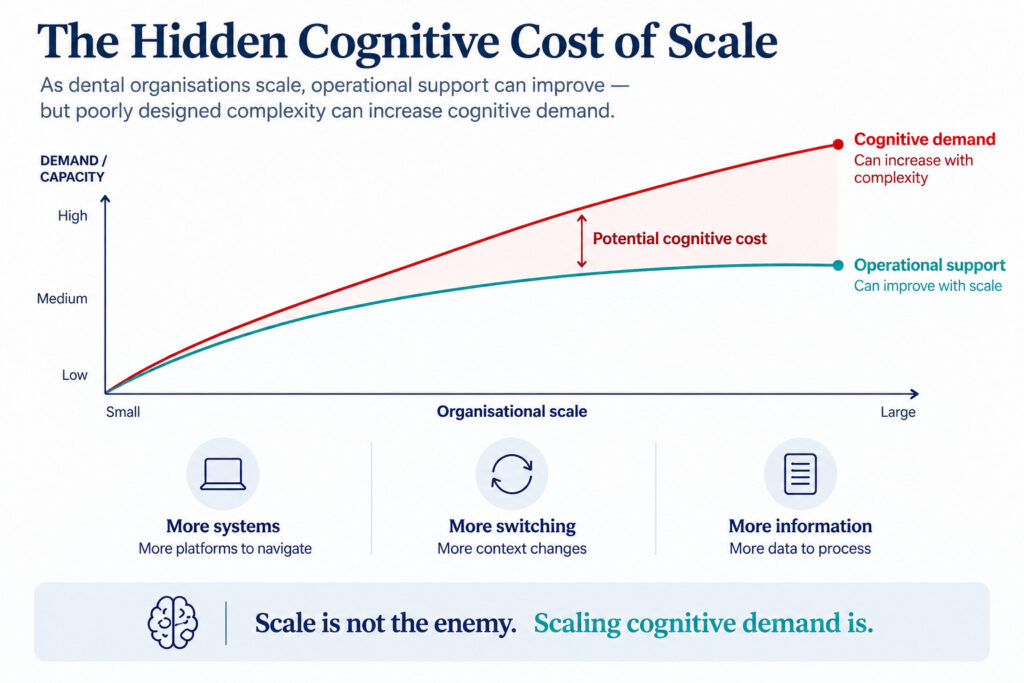
But growth can also introduce something less visible: cognitive friction.
Clinicians already make complex decisions, communicate with patients, manage risk, and respond to constant changes in their environment. If we then add multiple platforms, messages, metrics, workflows, and interruptions, the cumulative mental demand can become significant.
This friction can also appear in less obvious ways. For example, when a regular dental nurse is replaced by a locum or unfamiliar team member, tasks that normally happen almost automatically may require more verbal instruction, checking, and coordination. Similarly, a clinician may move rapidly between imaging interpretation, clinical decision-making, patient communication, and documentation, requiring attention to be repeatedly redirected.
The issue is rarely one additional system or one additional message. It is the constant switching between them.

Research has shown that working memory—our limited capacity to temporarily hold and process information—can become overloaded when too many competing demands are placed upon it. The more information a clinician is already holding and processing, the more disruptive an interruption can become, requiring them to reconstruct where they were and refocus attention.3,4
Furthermore, the effects of cognitive strain do not necessarily stop with the individual clinician. Cognitive fatigue can affect attention, decision-making, and consistency, with potential consequences for clinical performance and patient care. While cognitive fatigue and burnout are distinct, the wider evidence on occupational strain demonstrates why sustained pressure on clinicians should matter to organizations.
The wider healthcare evidence points in the same direction: A meta-analysis of 170 studies involving more than 239,000 physicians found burnout was associated with reduced productivity, twice the likelihood of patient-safety incidents, more than twice the likelihood of patient dissatisfaction, and more than three times the likelihood of turnover intention.
For a DSO, these are not merely isolated well-being outcomes. What begins as strain on the individual can ultimately appear as a performance, patient experience and retention problem for the organization.
This creates an important distinction: Operational efficiency and cognitive efficiency are not necessarily the same thing.
A system may be efficient from the organization’s perspective while creating additional mental work for the person using it. An organizational neuroscience perspective therefore asks not only, “Does this system work?” but also, “What does this system require from the human brain?”
Technology Is Not the Problem. Design Is.
Electronic health records illustrate the point.
Digital systems have transformed access to information and are fundamental to modern healthcare. Yet a systematic review found that poor usability and the amount of time clinicians spend using EHRs are significant contributors to EHR-related stress and burnout.7 Other research has highlighted how complex interfaces, documentation demands and navigating multiple sources of information can contribute to cognitive overload.³
The lesson is not that technology is the problem.
Technology should reduce cognitive work, not simply relocate it.
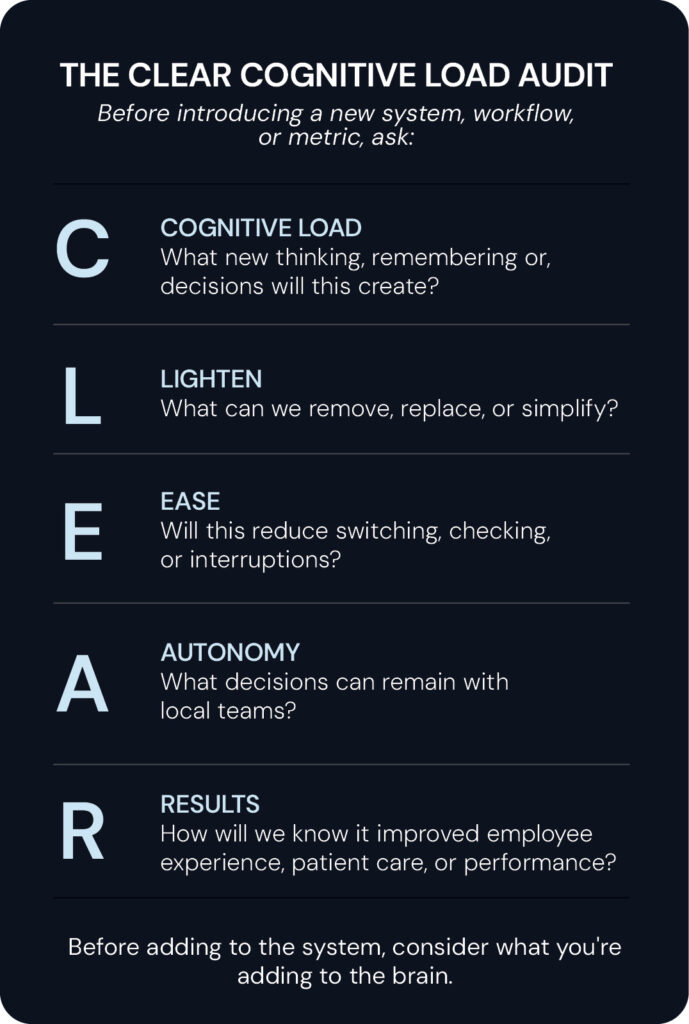
The same principle applies to organizational systems. Every new dashboard, communication channel, policy, or workflow should be considered not only for the efficiency it creates but also for the cognitive demand it introduces.
When Scale Becomes a Relationship Problem
There is another cost of growth that is harder to measure.
As organizations become larger, employees can feel further removed from the people making decisions. Processes become more standardized, targets become more visible, and individual contributions become harder to see. At some point, a clinician may begin to feel like a cog in the machine.
That matters because retention is not simply a financial calculation; it’s roots lie much deeper than that. A 2025 systematic review of healthcare organizational culture and provider work satisfaction identified multiple recurring factors, including communication, leadership, teamwork, involvement in decision-making, recognition, and autonomy.8 These are strikingly human variables, reinforcing the point that salary alone does not determine whether someone stays.
They also tell us something important about scale:
People do not necessarily resist being part of a large organization. They resist feeling insignificant within one.
Some large healthcare organizations are beginning to recognise this. Cleveland Clinic, for example, has incorporated well-being, professional development and employee experience into its organizational approach across a workforce of more than 80,000 caregivers. While its reported caregiver satisfaction outcomes are organizational rather than independent evidence, the model demonstrates that scale does not have to mean disconnection.9

There is much DSO leaders can learn from Cleveland Clinic’s approach: connecting caregivers with mentors, providing individual coaching, or creating dedicated decompression spaces—one of my personal favorites. Its Lavender Lounges provide quiet spaces for caregivers to step away and recharge, with one nursing director reporting more positive feedback about the lounges than almost any other initiative.10

Interestingly, these intentionally curated, neuro-informed spaces appear to work. In a recent study across 18 US hospitals, “Recharge Rooms” incorporating nature, low lighting, aromatherapy, music, and other calming sensory elements were associated with a 59% reduction in healthcare workers’ self-reported stress, alongside improvements in alertness and mood.¹¹
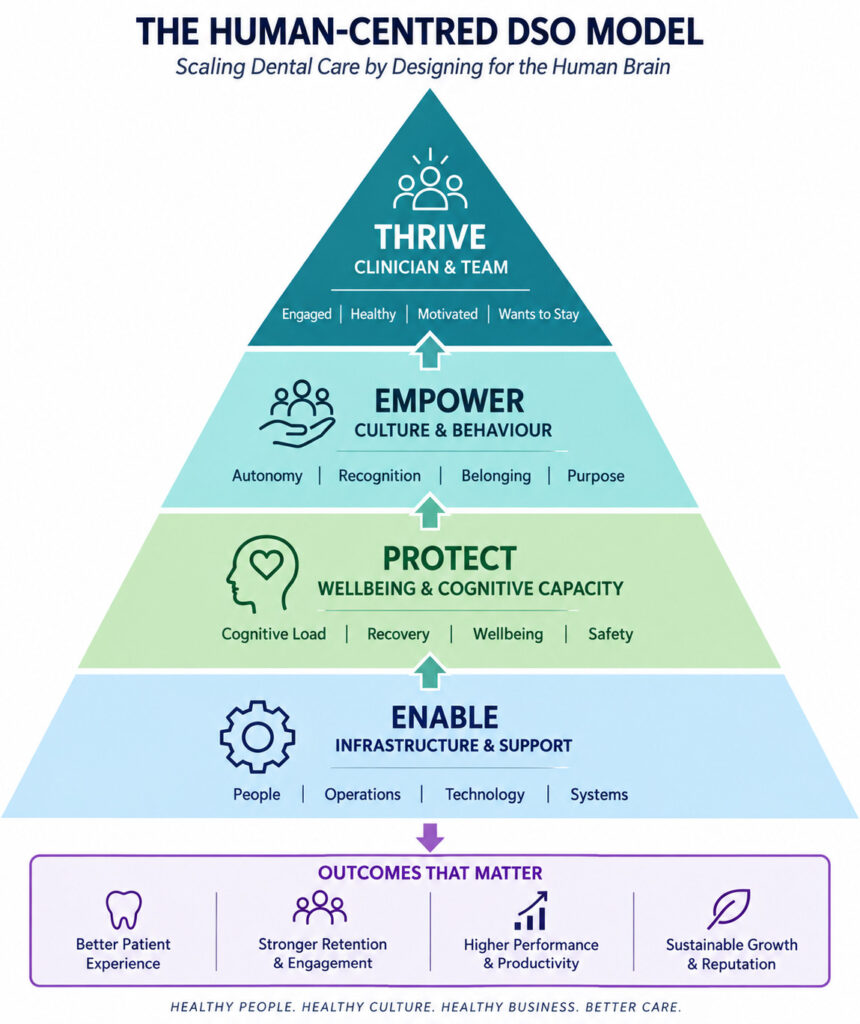
It does not have to be a Google-style nap pod or Microsoft Treehouse. The principle is much simpler: Design intentionally for the human brain. A thoughtfully curated space signals: we recognize that your work is demanding, we understand that you are human, and we have created somewhere for you to recover. When clinicians feel honestly valued and understood, we create not just better places to work, but also organizations that people feel entirely connected to—and want to stay a part of.
Loyalty Has to Be Earned
It would be too simplistic to say that today’s workforce is simply less loyal. A better interpretation is that loyalty can no longer be assumed.
When people feel valued, have appropriate autonomy, understand the purpose of their work, and can see opportunities to develop, they have reasons to build a relationship with an organization.
If they feel interchangeable, overwhelmed by unnecessary processes, or disconnected from decision-making, they have fewer reasons to stay.
Importantly, organizational design itself can be an intervention. A 2025 systematic review of organization-directed interventions found effects across areas including workload, job control, support, leadership, concentration, job satisfaction, engagement, and turnover intentions, although the evidence quality was low and results were mixed.12
The message for DSO leaders is clear:
Well-being should not sit alongside operational performance. It is part of it.
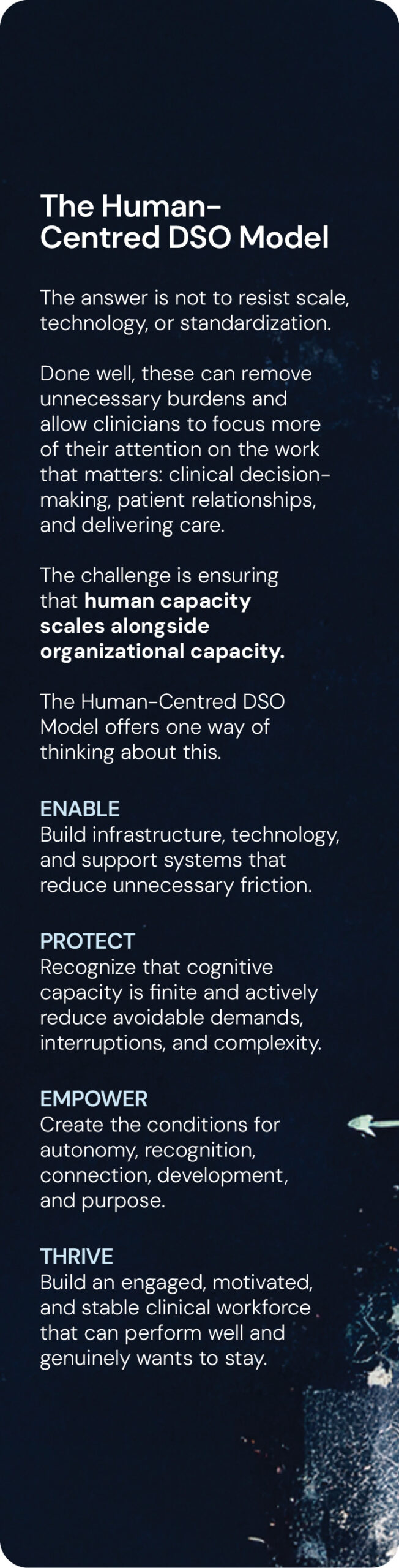
The framework is not about removing pressure from healthcare (clinical work will always be demanding). Indeed, it is about distinguishing between the demands inherent to clinical care and the demands we unnecessarily create around it.
From Resilience to Redesign
Healthcare has traditionally placed much of the responsibility for coping with pressure on the individual. We talk about resilience, mindfulness, stress management and well-being.
Although these have a place, the term resilience should not become a mechanism for making poorly designed systems sustainable.
A more useful question for leaders may be: What are we asking our people to be resilient to?
Where are we creating unnecessary cognitive friction? Where are interruptions built into the workflow? Where have we added technology without removing anything else? Where has standardization unintentionally reduced autonomy? And where might an employee feel like just another number in a growing organization?
These are not soft questions. They are questions about organizational design, performance, and retention.
Scaling the Organization, Not the Cognitive Load
Dental organizations will continue to grow. Technology will become more sophisticated. AI will reshape workflows, and standardization will remain an important part of delivering care at scale.
The answer is not to resist growth. It is to ensure that human cognition is considered alongside financial and operational capacity.
We cannot endlessly scale the demands placed on the human brain. We can, however, design better systems around it.
Perhaps the most important question for the next generation of DSO leaders is therefore not simply:
“How fast can we grow?”
It is:
“Can our people think, perform, and thrive at the speed at which we are asking the organization to grow?”
If the answer is yes, scale becomes an advantage.
If the answer is no, the hidden cost of growth may eventually appear in the places leaders care about most: performance, patient experience, and retention.
Scale the organization, not the burden.
REFERENCES
1. US Bureau of Labor Statistics, Employee Tenure in 2024 (September 2024).
2. Gallup, “Global Indicator: Employee Retention & Attraction,” 2026 data.
3. E. Asgari et al., “Impact of Electronic Health Record Use on Cognitive Load and Burnout Among Clinicians: Narrative Review,” JMIR Medical Informatics (2024).
4. G. Trépanier et al., “A Battle for Attention: How Do Emergency Physicians Respond to Interruptions? A Scoping Review,” CJEM 27, no. 11 (2025): 911–19, https://doi.org/10.1007/s43678-025-00950-1.
5. A. Yansane et al., “Burnout, Engagement, and Dental Errors Among U.S. Dentists,” Journal of Patient Safety 17, no. 8 (2021): e1050–e1056, https://doi.org/10.1097/PTS.0000000000000673.
6. A. Hodkinson et al., “Associations of Physician Burnout with Career Engagement and Quality of Patient Care: Systematic Review and
Meta-analysis,” BMJ 378 (2022): e070442, https://doi.org/10.1136/bmj-2022-070442.
7. F. Alobayli et al., “Electronic Health Record Stress and Burnout Among Clinicians in Hospital Settings: A Systematic Review,” Digital Health (2023).
8. M. R. Rafii, S. A. Md Hanif, and F. B. Daud, “Exploring the Link between Healthcare Organizational Culture and Provider Work Satisfaction: A Systematic Review,” BMC Health Services Research 25 (2025): 904, https://doi.org/10.1186/s12913-025-12973-6.
9. Cleveland Clinic, Serving Our Present, Caring for Our Future: Progress in Community and Global Citizenship (2022), “Engagement Surveys and Action Planning.”
10. Cleveland Clinic, “Lavender Lounges Offer an Emotional Oasis on Inpatient Units,” Consult QD, April 23, 2026.
11. L. Cooke et al., “Multisensory Nature-Based Recharge Rooms’ Effect on Healthcare Workers in a Multicenter Study,” Frontiers in
Psychology 16 (2026): 1706772, https://doi.org/10.3389/fpsyg.2025.1706772.
12. A. Boskma et al., “Effectiveness of Organization-Directed Interventions on Healthcare Professionals’ Well-Being: A Systematic Review,”
eClinicalMedicine 88 (2025): 103496, https://doi.org/10.1016/j.eclinm.2025.103496.

With additional expertise in dental law, ethics, and neuro-linguistic programming, Anum has contributed to leading dental publications, including BDJ In Practice and The Dentist, and delivers education for organizations, including the British Dental Association and Women in DSO®. She is also coauthor of the forthcoming