By Rachel W. Morrissey, Deesha Bhaumik, and Dr. Marko Vujicic
Access to dental care through Medicaid has long been a critical lifeline for millions of American adults and children, yet the future of the program is uncertain. The COVID-19 pandemic disrupted both provider participation and patient utilization, creating ripple effects that are still being felt today. As states expand benefits and policymakers debate reforms, recognizing who is delivering dental care, and who is receiving it, is critical to understanding the complete picture of oral health in the United States.
In this article we consider both sides of the story, looking at utilization by the patients who rely on these benefits as well as the providers who treat them. We explore how utilization patterns differ between children and adults, which groups have recovered since the pandemic, and trends in provider characteristics and practice types.
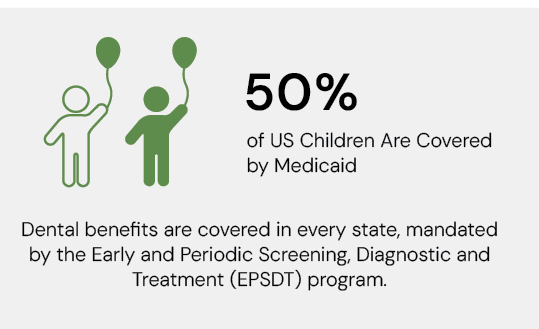
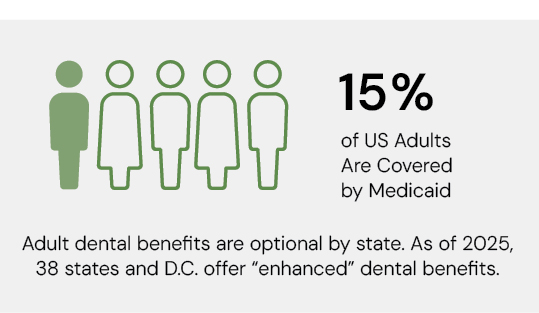
Let’s begin with a brief overview of dental benefits within Medicaid programs. Around 50% of children and 15% of adults in the US are covered by Medicaid or the Children’s Health Insurance Program (CHIP). In the US, dental services are covered for child Medicaid and CHIP beneficiaries in every state, mandated by the Early and Periodic Screening, Diagnostic, and Treatment program. For adults, dental benefits under Medicaid are optional, and each state can decide if and how they want to expand coverage for dental services. As of 2025, 38 states and the District of Columbia offer enhanced benefits (i.e., those that cover a substantial amount of diagnostic, preventive, and restorative services) for adult Medicaid beneficiaries.
Although child beneficiaries have dental coverage under Medicaid and CHIP in every state, a considerably low number have visited a dentist in the past 12 months. Dental care utilization varies widely by state, ranging from 30% to 62%, and in 27 states only 50% of Medicaid and CHIP beneficiaries utilized dental care in the past year. This is 20 percentage points lower than the dental care utilization for privately insured children, and this gap has persisted for the last decade. Utilization among both groups dropped sharply during the pandemic, and neither appear to have fully recovered.
For adults, utilization rates for Medicaid beneficiaries remains flat and is considerably lower than for privately insured individuals. As of 2022 (the most recent year for which adult utilization data is available) the national adult Medicaid beneficiary utilization rate was 18%, and no state had a rate above 33%. States with enhanced benefits saw higher utilization among adult Medicaid beneficiaries than states with limited or emergency-only benefits. By comparison, utilization among privately insured adults is nearly 40 percentage points higher; while it dropped sharply during the pandemic, it has since recovered and even surpassed pre-pandemic levels.
Turning to the provider side, dentist participation in Medicaid or CHIP has remained stagnant over the last decade, although many states have expanded benefits since 2015. As of 2024, 41% of US dentists participate in Medicaid or CHIP, meaning they are enrolled as a Medicaid or CHIP provider through InsureKidsNow.gov or work at a federally qualified health center. There is a wide variation in participation across states, ranging from 22% to 76%.
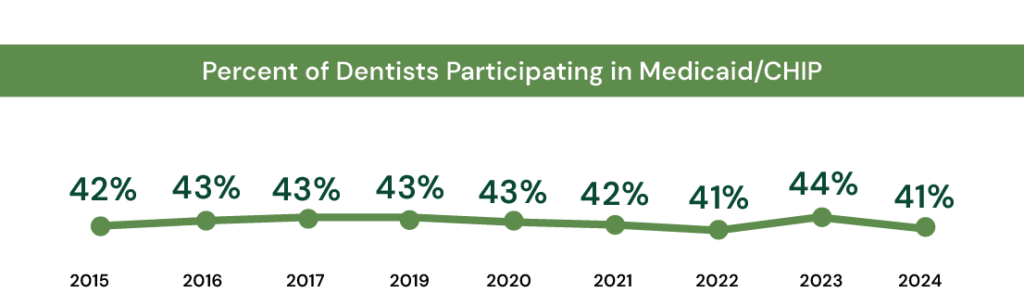
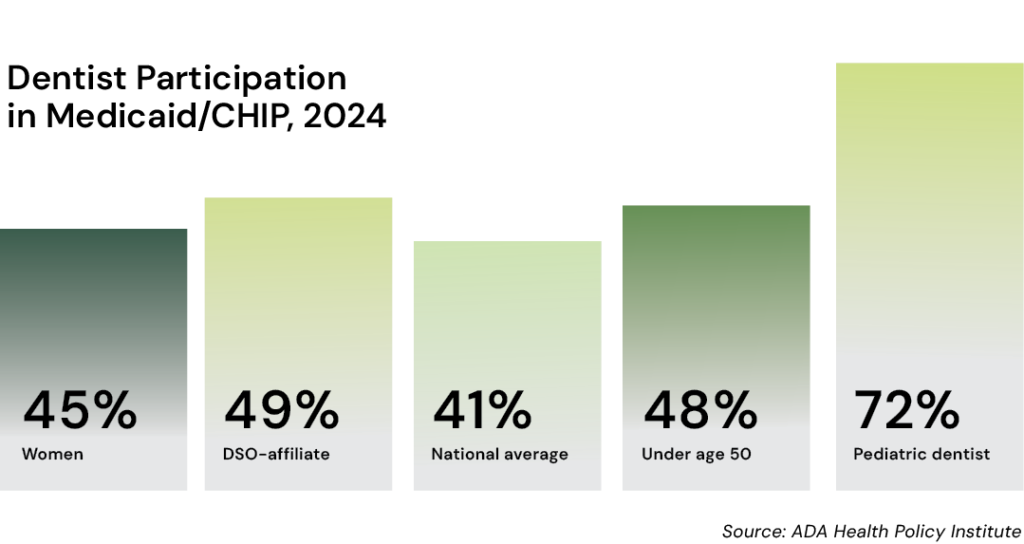
Who are the practitioners more likely to treat Medicaid and CHIP beneficiaries? Our analysis revealed certain patterns. First, women dentists are more likely to participate in Medicaid than men (45% vs 39%). Like Medicaid participation overall, participation rates by gender have remained stable for men and women dentists since 2015.
Practice type is also a factor. Participation is higher among dentists in DSOs than it is for dentists not in a DSO-affiliated practice (49% vs 39%). However, while rates have been steady for dentists overall, participation among DSO-affiliated dentists is dropping. Ten years ago, roughly two-thirds of DSO-affiliated dentists participated in Medicaid or CHIP. As of 2024, this figure has dropped to just under half—a considerable decline but still higher than participation rates overall. This drop may be partly explained by the expansion and composition of the DSO market over time.
Black dentists and those younger than 50 have higher participation rates than other groups. Dentists up to 10 years out of dental school also have higher participation rates, although the rate has declined since 2015. Compared to other specialties, pediatric dentists have the highest participation rate by far, at 72% in 2024. This figure has been stable since 2015.
It will be interesting to observe the pattern of Medicaid participation in the coming years as demographic and practice trends shift the dental workforce. As mentioned in our earlier article, dentistry is in the middle of a generational transition, and the workforce is increasingly young, racially diverse, female, and DSO-affiliated.
One factor to consider with respect to dentist participation is the Medicaid reimbursement for fee-for-service (FFS) as a percent of average dentist charges. In the majority of states, Medicaid FFS reimbursement rates are less than half of what dentists typically charge for both children and adult dental services. Although there have been recent Medicaid reimbursement rate increases, they have generally not been large enough to close the existing gap between dentist charges and private insurance reimbursement. This results in a tough landscape to attract more dentists to participate in Medicaid.
As Medicaid continues to evolve, dental benefits will remain a critical component of health policy discussions. With continued collaboration and thoughtful policy decisions, there is real potential to ensure that every child and adult has access to the dental care they need for overall health.